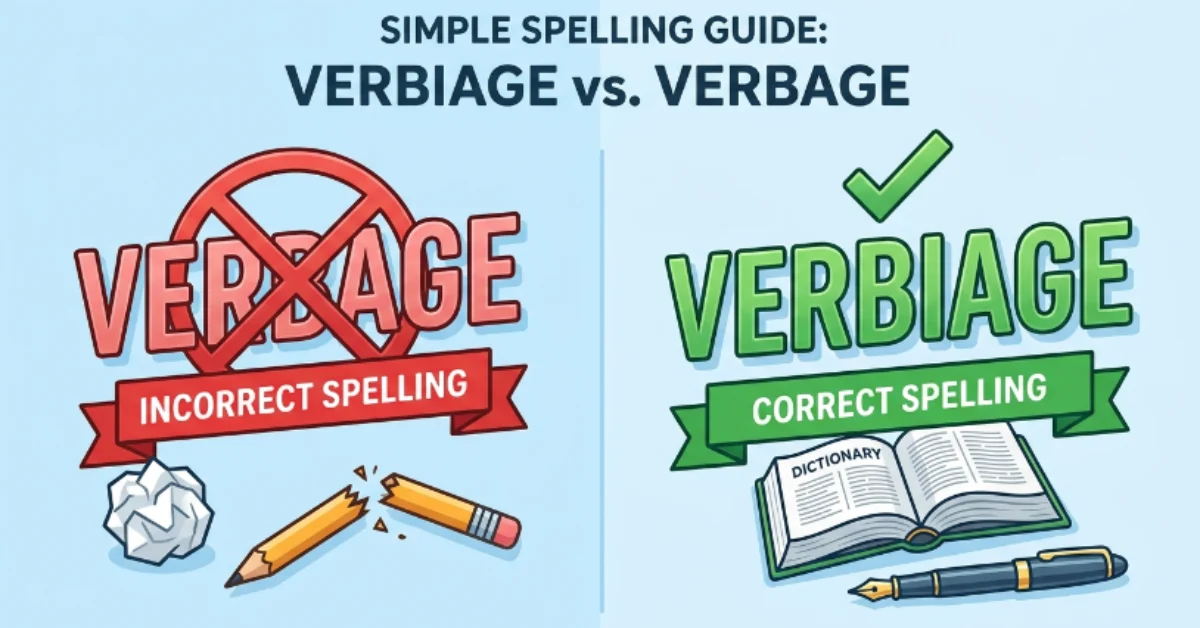
Verbiage is the correct spelling, while verbage is generally considered a misspelling in standard English. The confusion happens because many people pronounce the word in a way that makes the second spelling seem logical.
This guide explains the correct spelling, meaning, grammar rule, examples, and why the mistake is so common.
Quick Answer
| Word | Is It Correct? | Meaning |
|---|---|---|
| Verbiage | ✅ Yes | Excessive, unnecessary, or overly complicated wording. |
| Verbage | ❌ No (standard English) | A common misspelling of verbiage. |
If you’re deciding between verbage or verbiage, always choose verbiage in formal writing, academic work, business communication, and professional documents.
Most major dictionaries, including Merriam-Webster, Cambridge Dictionary, and the Oxford English Dictionary, recognize verbiage as the standard spelling.
Why People Misspell Verbiage
Many English spelling mistakes happen because people write words exactly as they hear them. Verbiage is a perfect example.
When spoken quickly, the middle “i” is easy to miss. As a result, many people write verbage, assuming it follows the same spelling pattern as words ending in -age, such as package, village, or message.
Another reason is familiarity. The ending -age appears in hundreds of English words, so our brains naturally expect the same pattern here.
According to Merriam-Webster, however, the accepted spelling is verbiage. Although verbage appears occasionally in informal writing and online discussions, it is generally treated as a nonstandard spelling and should be avoided in edited English.
If you’re writing an email, blog post, report, research paper, or business proposal, using verbiage helps maintain professionalism and grammatical accuracy.
The Correct Spelling — Rule Explained
The correct form is verbiage because it comes from the word verb, combined with the suffix -iage, which entered English through French.
Unlike many everyday words ending in -age, verbiage keeps the extra “i” as part of its historical spelling. It is not a modern spelling choice or a regional variation. It is simply the standard form recognized in modern English.
Today, dictionaries define verbiage in two common ways:
- An excessive amount of words.
- Language that is unnecessarily complicated or wordy.
Editors often use the term when advising writers to remove unnecessary words and improve clarity, conciseness, and effective communication.
Memory Trick
Remember this simple rule:
VERB + I + AGE = VERBIAGE
If you can remember the word verb, you’ll remember the extra “i” in verbiage.
Think of it this way:
- Verb → the root word
- Verbiage → language built from words
- Verbage → missing an important letter
That single “i” makes all the difference.
Keeping this trick in mind can help you avoid one of the most common English spelling mistakes and improve your writing, proofreading, and editing skills.
Correct vs Incorrect — At a Glance
| Incorrect Form | Correct Form | Why It’s Wrong |
|---|---|---|
| Verbage | Verbiage | Verbage is a nonstandard spelling and is not recognized by major dictionaries as the preferred form. |
| Verbage in a report | Verbiage in a report | Professional and academic writing should always use verbiage. |
| Too much verbage | Too much verbiage | The correct spelling includes the letter “i” after verb. |
| Remove the verbage | Remove the verbiage | Editors and proofreaders use verbiage when referring to unnecessary wording. |
Quick Tip: If your spell checker highlights verbage, replace it with verbiage before publishing or submitting your work.
Example Sentences (Correct Usage)
Everyday Conversations
- The email contained so much verbiage that I almost missed the main point.
- Try to avoid unnecessary verbiage when explaining simple ideas.
Formal and Professional Writing
- The editor removed excessive verbiage to make the report clearer and more concise.
- Good business writing avoids verbiage and focuses on clear communication.
Academic and Social Media
- The professor advised students to reduce verbiage in their research papers.
- Great content doesn’t need fancy verbiage—it needs clear ideas that readers can understand.
Why Verbiage Often Has a Negative Meaning
Although verbiage simply refers to wording or language, it often carries a negative tone.
Writers, editors, and teachers usually use the word when they believe a piece of writing contains too many unnecessary words. Instead of improving the message, the extra wording makes it harder to read.
For example:
❌ The report contains unnecessary verbiage.
This means the report could be shorter and clearer.
However, context matters. In some dictionaries, verbiage can simply mean “wording” without criticizing the writing. Even so, modern usage most often implies wordiness, verbosity, or redundant language.
Common Mistakes People Make
Here are some of the most frequent errors related to verbage or verbiage.
❌ The proposal contains too much verbage.
✅ The proposal contains too much verbiage.
Always use the standard spelling in formal English.
❌ Please reduce the verbage in this paragraph.
✅ Please reduce the verbiage in this paragraph.
Editors use verbiage when referring to excessive wording.
❌ Verbage makes your writing difficult to understand.
✅ Verbiage makes your writing difficult to understand.
The extra “i” is part of the correct spelling.
❌ Oxford Dictionary lists verbage as the preferred spelling.
✅ Oxford Dictionary lists verbiage as the preferred spelling.
Major dictionaries recognize verbiage as the standard English spelling.
Tips to Remember the Correct Spelling
Learning one simple memory trick can prevent this mistake forever.
- Think of the root word verb.
- Add the letters iage to complete the word.
- Remember: Verb + iage = Verbiage.
Another helpful tip is to read your writing aloud during proofreading. If a word looks unusual, check it in a trusted dictionary definition before publishing.
Using grammar tools can also help catch common spelling mistakes, but developing the habit of recognizing commonly confused words will improve your writing in the long run.
Whether you’re creating a blog post, academic paper, email, or business document, choosing the correct spelling reflects stronger English vocabulary, better word usage, and more polished professional writing.
FAQs
Is verbage a real word?
Verbage appears occasionally in informal writing, but it is generally considered a misspelling of verbiage in standard English. For professional, academic, and formal writing, always use verbiage.
Is verbiage the correct spelling?
Yes. Verbiage is the correct spelling recognized by major dictionaries, including Merriam-Webster, Cambridge Dictionary, Collins Dictionary, and the Oxford English Dictionary.
Why do people write verbage instead of verbiage?
Many people spell it verbage because the word is often pronounced quickly, making the extra “i” difficult to hear. The common -age ending in English also encourages this spelling mistake.
What does verbiage mean?
Verbiage usually means an excessive amount of words or language that is unnecessarily long or complicated. It often suggests that writing could be shorter and clearer.
Is verbiage always negative?
Not always. Some dictionaries define it simply as “wording” or “language.” However, in modern writing and editing, verbiage usually has a negative meaning because it refers to unnecessary or wordy text.
How do you use verbiage in a sentence?
Example:
“The editor removed unnecessary verbiage to improve the article’s clarity.”
Here, verbiage refers to extra words that do not add value.
What is another word for verbiage?
Common synonyms include:
- Wordiness
- Verbosity
- Redundancy
- Long-windedness
- Circumlocution
- Prolixity
- Excessive wording
- Filler language
The best synonym depends on the context.
How can I avoid using too much verbiage?
Focus on clear communication. Remove unnecessary words, avoid repetition, use precise vocabulary, and proofread your work carefully. Strong writing is usually concise, direct, and easy to understand.
Final Thoughts
When choosing between verbage or verbiage, the correct answer is simple: verbiage is the standard English spelling, while verbage is a common misspelling that should be avoided in formal writing.
Remember the easy memory trick—Verb + iage = Verbiage—and you’ll rarely make this mistake again. Clear, concise writing is always more effective than unnecessary verbiage, whether you’re writing an email, blog post, business report, or academic paper.
Related Blogs:

Hi, I am Constance Hale, an author featured on Grammerdesk.com. I focus on language, writing style, and grammar, helping readers improve clarity, expression, and effective communication in English.