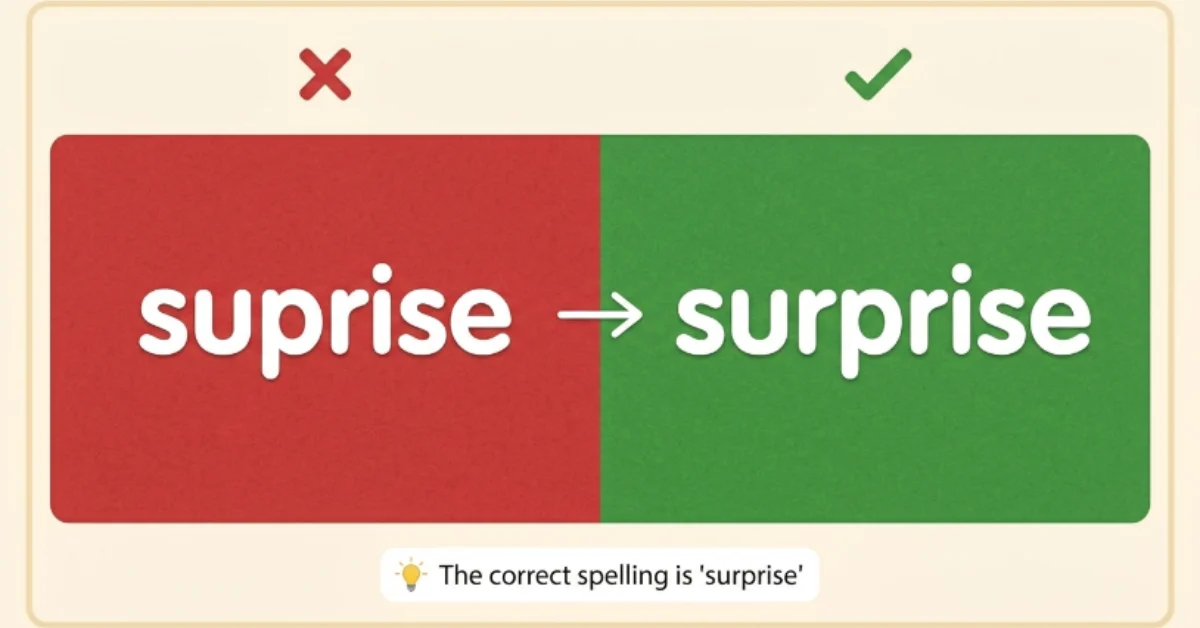
Surprise is the correct spelling, while suprise is an incorrect spelling in standard English. The mistake happens because the first “r” is easy to overlook when writing or typing the word.
This guide explains the correct spelling, meaning, grammar rule, pronunciation, examples, and practical tips to help you avoid this common spelling mistake.
Quick Answer
| Word | Is It Correct? | Meaning |
|---|---|---|
| Surprise | ✅ Yes | An unexpected event, feeling, or action that causes amazement or shock. |
| Suprise | ❌ No | A common misspelling of surprise. |
If you’re wondering whether to write suprise or surprise, always choose surprise. It is the only spelling recognized by major dictionaries, including Merriam-Webster, Cambridge Dictionary, Oxford English Dictionary, and Collins Dictionary. The spelling suprise should be avoided in academic writing, business communication, professional emails, and everyday writing.
Why People Misspell Surprise
The confusion between suprise and surprise is easy to understand.
When people pronounce the word, the first “r” is not strongly emphasized. As a result, many writers accidentally drop the letter and write suprise instead of surprise.
Fast typing also contributes to the mistake. Since the letters r and p appear close together in the middle of the word, it’s common to skip one of them without noticing.
English learners and even native speakers sometimes make this error because English spelling does not always match pronunciation. This is why proofreading, using a reliable spell checker, and checking a trusted dictionary definition are good habits when writing.
According to Merriam-Webster and the Cambridge Dictionary, surprise is the only accepted spelling in modern English. The form suprise is considered a misspelling and should not be used in formal or professional writing.
The Correct Spelling — Rule Explained
The correct spelling is surprise.
It contains two “r” letters—one after su and another before ise:
S U R P R I S E
Many people accidentally remove the first “r”, producing suprise, but this spelling is incorrect.
The word surprise entered English from Old French and has kept its traditional spelling for centuries. Although its pronunciation may tempt people to simplify it, standard English spelling has not changed.
Today, surprise can function as both a noun and a verb.
As a noun, it means an unexpected event or feeling.
- The birthday party was a wonderful surprise.
As a verb, it means to astonish or catch someone unexpectedly.
- Her announcement surprised everyone in the meeting.
Whether you’re writing a school assignment, business report, blog post, or social media update, using the correct spelling reflects strong English vocabulary, accurate word usage, and careful editing.
Memory Trick
Remember this simple formula:
SUR + PRISE = SURPRISE
Notice the “PR” in the middle.
If you remove the first “R”, you get suprise, which is incorrect.
Another easy way to remember it is this:
A real surprise has two surprises—the two letter “R”s.
Whenever you’re unsure, think of two R’s = correct spelling. This simple trick can help you avoid one of the most common English spelling mistakes.
Correct vs Incorrect — At a Glance
| Incorrect Form | Correct Form | Why It’s Wrong |
|---|---|---|
| Suprise | Surprise | Suprise is a misspelling and is not recognized in standard English. |
| A big suprise | A big surprise | The correct spelling always includes the first “r”. |
| Suprise party | Surprise party | Use surprise in both formal and informal writing. |
| Suprised | Surprised | The past tense and adjective also keep both “r” letters. |
Quick Tip: If your grammar checker or spell checker flags suprise, replace it with surprise before publishing or submitting your work.
What Does Surprise Mean?
The word surprise has two main uses in English.
As a noun, it refers to an unexpected event, unexpected occurrence, or feeling of astonishment, amazement, or shock.
Examples:
- The gift was a complete surprise.
- Winning the competition came as a pleasant surprise.
As a verb, surprise means to catch someone unexpectedly or make them feel amazed.
Examples:
- Her kind words surprised me.
- The news surprised everyone in the office.
Whether you’re writing an email, blog post, report, or school assignment, using the correct spelling helps ensure language accuracy, clear communication, and professional writing skills.
Example Sentences (Correct Usage)
Everyday Conversations
- Your visit was such a wonderful surprise.
- I wanted to surprise my parents with dinner.
Formal and Professional Writing
- The company’s announcement came as a pleasant surprise to investors.
- The manager planned a surprise appreciation event for the team.
Academic Writing
- The researchers were surprised by the unexpected results.
- The discovery was a significant surprise for the scientific community.
Social Media
- What a surprise! I finally reached one million followers.
- Thanks for the birthday surprise—it made my day!
Common Mistakes People Make
Many spelling mistakes happen because writers rely on pronunciation instead of checking the correct spelling.
Here are the most common errors.
❌ It was a huge suprise.
✅ It was a huge surprise.
Always include both “r” letters.
❌ I have a suprise for you.
✅ I have a surprise for you.
The noun is always spelled surprise.
❌ She suprised everyone with the news.
✅ She surprised everyone with the news.
The past tense surprised also contains both “r” letters.
❌ The suprise party was amazing.
✅ The surprise party was amazing.
This is one of the most common spelling errors in everyday English.
❌ Suprise is the correct spelling.
✅ Surprise is the correct spelling.
Major dictionaries recognize only surprise as the standard spelling.
Tips to Remember the Correct Spelling
A simple memory trick can help you spell surprise correctly every time.
- Think of the word as SUR + PRISE.
- Pay attention to the “PR” in the middle.
- If one “R” disappears, the spelling is wrong.
Another useful habit is to proofread your writing before sending emails, submitting assignments, or publishing blog posts. Even experienced writers occasionally make common spelling mistakes, but careful editing and a reliable spell checker can catch them quickly.
Improving your English vocabulary, understanding spelling rules, and practicing proper word usage will make your writing clearer, more accurate, and more professional.
FAQs
Is suprise a real word?
No. Suprise is a common misspelling of surprise. Standard dictionaries, including Merriam-Webster, Cambridge Dictionary, and the Oxford English Dictionary, recognize only surprise as the correct spelling.
Is surprise the correct spelling?
Yes. Surprise is the only correct spelling in modern English. It should be used in everyday writing, academic papers, business communication, and professional documents.
Why do people spell surprise as suprise?
Many people accidentally omit the first “r” because it is not strongly pronounced. Fast typing and relying on pronunciation instead of spelling also contribute to this common mistake.
How do you spell surprise correctly?
The correct spelling is:
S-U-R-P-R-I-S-E
A simple way to remember it is that surprise always contains two “r” letters.
What does surprise mean?
As a noun, surprise means an unexpected event or feeling of amazement.
As a verb, it means to astonish or catch someone unexpectedly.
Is surprise a noun or a verb?
Both.
- Noun: The birthday gift was a wonderful surprise.
- Verb: Her announcement surprised everyone.
The meaning depends on how the word is used in the sentence.
What are some synonyms for surprise?
Common synonyms include:
- Astonishment
- Amazement
- Shock
- Wonder
- Revelation
- Unexpected event
- Startlement
- Discovery
Choose the synonym that best matches your context.
How can I avoid spelling surprise incorrectly?
Practice writing the word correctly, proofread your work, and use a trusted spell checker or dictionary when you’re unsure. Reading regularly also helps reinforce correct spelling and improves your overall English vocabulary.
Final Thoughts
When choosing between suprise or surprise, the correct spelling is always surprise. The form suprise is a common spelling mistake that should be avoided in standard English. Remember the simple memory trick—SUR + PRISE—and don’t forget that the word contains two “r” letters.
Using the correct spelling will strengthen your writing skills, improve language accuracy, and help you communicate more clearly in academic, professional, and everyday writing.
If you found this guide helpful, you might also want to read our article on Verbage or Verbiage to avoid another common English spelling mistake.

Hi, I’m Gerald Graff, a writer at GrammerDesk.com. I create simple, practical guides on English grammar, confusing words, homophones, spelling, and common language mistakes to help readers write and communicate with confidence.