Have you ever read a review or heard someone say something was “fair” and wondered how it is different from “good”?
This confusion is very common because both words are used to describe quality, performance, and everyday situations, but they do not mean the same thing. Many English learners, students, and even professionals struggle to understand when to use fair vs good correctly.
In simple terms, fair usually means average or acceptable, while good shows something positive and above average. In this article, you will clearly understand the difference between fair and good with simple explanations, real-life examples, and usage tips.
By the end, you will never confuse these two words again and will confidently use them in writing and speaking.
Quick Answer — Fair vs Good Difference
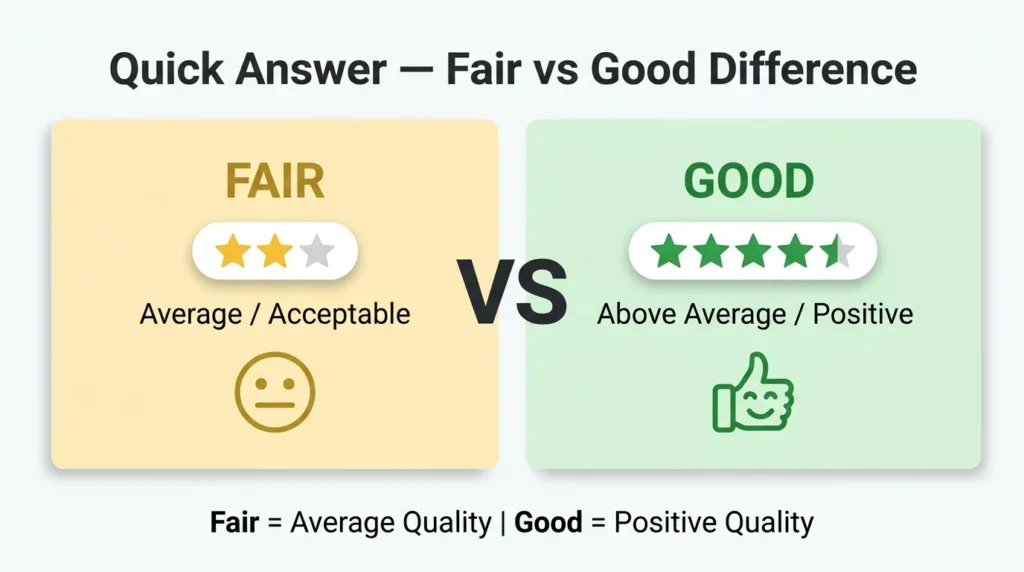
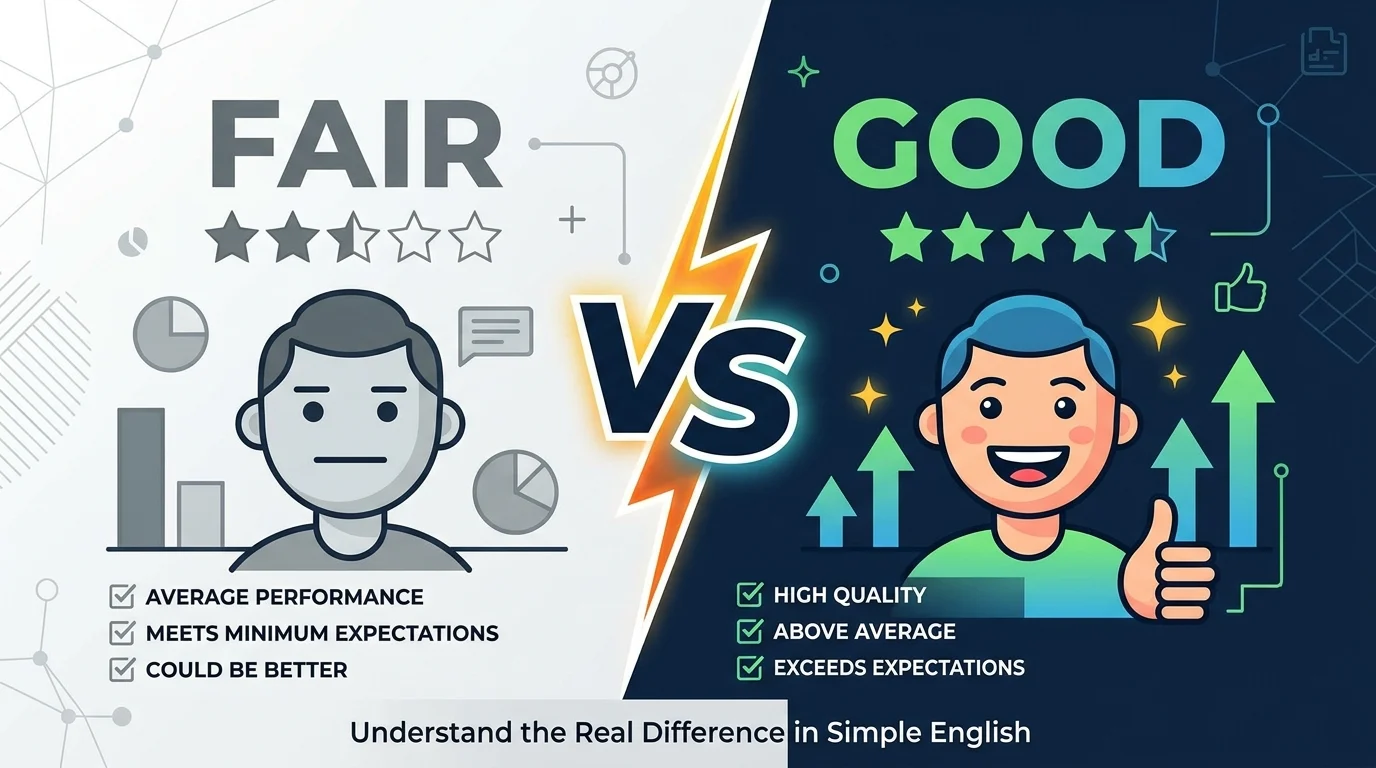
The words “fair” and “good” are both adjectives used to describe quality, but they differ in strength and meaning. Fair means something is average, acceptable, or moderate, sitting in the middle of a quality scale. It does not show strong approval or disapproval.
On the other hand, good means something is above average, positive, and satisfying, showing clear approval or a favorable opinion.
In simple terms, fair = okay or neutral quality, while good = positive and better-than-average quality. This difference makes “good” stronger and more desirable in most situations.
What Does “Fair” Mean?
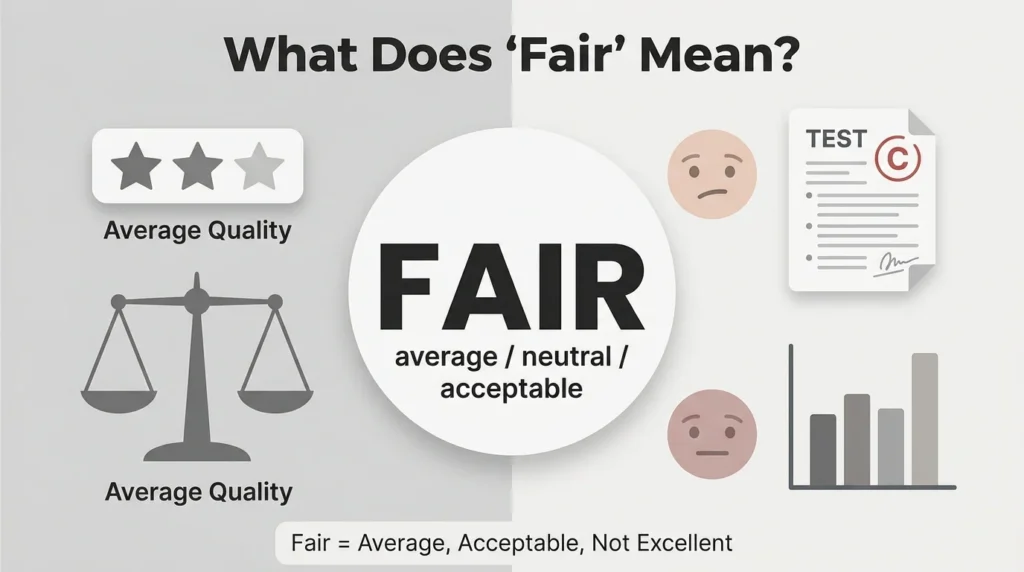
The word fair is used when something is neither bad nor excellent but falls in the middle range of quality. It is commonly used to express a neutral opinion where expectations are met but not exceeded. In many cases, “fair” indicates that something is acceptable but still has room for improvement.
In a broader sense, fair can also mean just, equal, and unbiased, especially when referring to rules, treatment, or decisions.
Fair in Quality Rating
When used to describe quality, fair means something is average or slightly below good. It does not express satisfaction, but it also does not indicate failure.
Fair is often used in:
- Product reviews
- Performance feedback
- Academic evaluations
👉 Example: The service was fair, but it could be improved in several areas.
Fair in Justice and Rule
In another important meaning, fair refers to equality, justice, and unbiased treatment. This usage is common in legal, social, and ethical contexts.
👉 Example: Everyone deserves a fair opportunity to succeed, regardless of background.
This meaning is separate from quality but is very important in everyday communication.
Examples in Sentences
- The weather today is fair and calm.
- His performance in the exam was fair, not excellent.
- The judge made a fair decision based on facts.
- The product quality is fair for its price range.
What Does “Good” Mean?
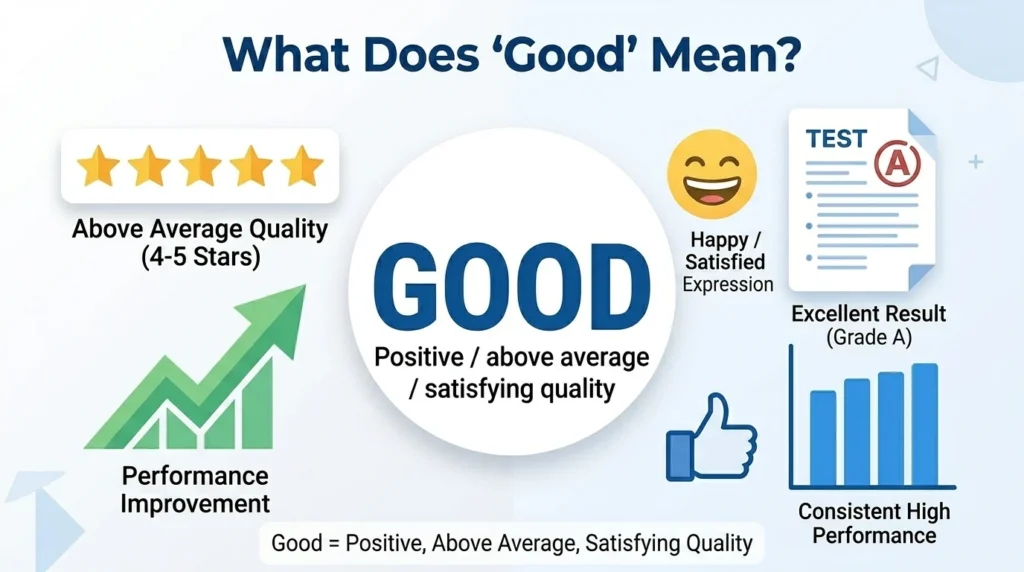
The word good is used to describe something that is positive, satisfactory, or above average in quality. It is one of the most commonly used positive adjectives in English and shows approval or appreciation.
“Good” indicates that something meets expectations well or even slightly exceeds them.
Good in Reviews and Feedback
In reviews, good means a product, service, or experience is reliable and satisfying. It is a positive judgment but not extreme praise like “excellent.”
👉 Example: The restaurant served good food with fresh ingredients and great service.
Good in Everyday English Usage
In daily communication, “good” is used to express satisfaction, success, or positive feelings.
👉 Example: She is doing a good job at her new workplace.
It is a flexible word used in both formal and informal situations.
Examples in Sentences
- The movie was really good and enjoyable.
- He is a good student with strong performance.
- The weather is good for traveling today.
- That was a good decision in the long run.
Fair vs Good on the Quality Scale
One of the best ways to understand the difference is through a quality scale, which is commonly used in ratings, reviews, and performance evaluations.
Quality Scale:
Poor → Fair → Good → Very Good → Excellent
- Fair represents a middle or acceptable level where performance is just okay.
- Good represents a higher level where performance is clearly positive and satisfying.
👉 This shows that “good” is always one step above “fair” in quality, making it more desirable in most situations.
Key Differences Between Fair and Good
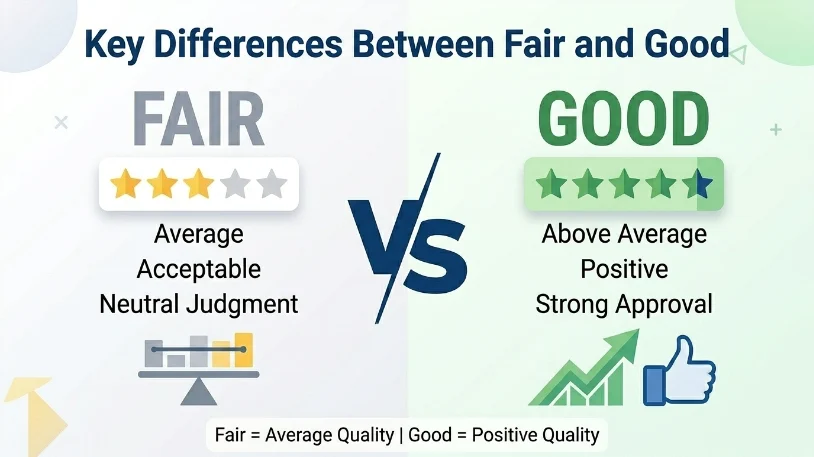
The difference between fair and good becomes clearer when we compare them directly.
| Feature | Fair | Good |
|---|---|---|
| Meaning | Average or acceptable | Positive and above average |
| Tone | Neutral | Positive |
| Strength | Moderate | Strong approval |
| Emotional Impact | Balanced, non-strong | Satisfying and favorable |
| Usage | Neutral evaluation | Positive judgment |
👉 In simple terms, fair is “just okay,” while good is “clearly better and more satisfying.”
Fair vs Good in Real-Life Contexts
Understanding real-life usage helps clarify the difference even further.
Product Reviews and Ratings
- Fair: The product works but has limitations
- Good: The product performs well and satisfies expectations
👉 Example: The phone has fair battery life, but its camera quality is good.
Academic Grading
- Fair: Average or passing performance
- Good: Above-average performance
👉 Example: She received a fair grade, while her friend achieved a good score.
Workplace Feedback
- Fair: Meets basic expectations
- Good: Performs well and shows consistency
👉 Example: His report was fair, but her analysis was good and detailed.
Everyday Conversations
- The weather is fair today. (neutral)
- The weather is good today. (positive)
When Something Is Fair but Not Good
Sometimes something is fair but still not considered good. This happens when the result is acceptable but not satisfying.
Common situations:
- Passing marks in exams
- Basic job performance
- Average competition results
👉 Example: The decision was fair, but the outcome was not good for everyone involved.
When Something Is Good but Not Fair
In some cases, something may be good in outcome but not fair in process.
Examples include:
- Favoritism in selection
- Unequal opportunities
- Biased decisions
👉 Example: He got a good position, but the selection process was not fair.
Common Mistakes People Make
Many English learners confuse these words.
Common errors:
- Using “fair” when they mean positive feedback
- Assuming fair = good (incorrect)
- Ignoring context of usage
- Overusing “fair” in emotional praise situations
👉 Key rule: Fair = neutral, Good = positive
Fair vs Good in English Grammar Usage
From a grammar perspective, both words are adjectives, but their usage changes tone significantly.
- Fair is used for neutral descriptions or balanced opinions
- Good is used for positive evaluation or approval
Sentence comparison:
- The explanation is fair. (acceptable but average)
- The explanation is good. (clear and effective)
- Her performance was fair. (moderate)
- Her performance was good. (strong and positive)
👉 In grammar usage, “good” always carries stronger emotional weight than “fair.”
FAQs
Is fair better than good?
No, “good” is better because it shows higher quality and approval.
Is fair positive or negative?
Fair is neutral. It is neither strongly positive nor negative.
Can fair mean good?
No, fair usually means average or acceptable, not good.
Which is higher: fair or good?
Good is higher on the quality scale.
Is fair the same as good in grading?
No, fair usually means average, while good means above average.
Is fair the same as good?
No, fair is average or acceptable, while good is positive and above average in quality.
Which is better fair or good?
Good is better because it shows higher quality and stronger approval than fair.
What is the difference between fair and good?
Fair means neutral or average, while good means positive and satisfying quality.
Is being fair a quality?
Yes, fair is a quality level that represents average or acceptable performance.
Does fair mean pretty?
Not exactly—fair can mean average quality or sometimes attractive in old usage, but it does not mean “good-looking” in modern use.
What is better between fair and good?
Good is better as it indicates higher quality and positive judgment.
Is being fair a value?
Yes, fairness is also a value meaning justice, equality, and unbiased treatment.
Final Thoughts
The difference between fair vs good lies mainly in quality level and tone of meaning. Fair represents an average or acceptable condition, while good represents a positive and satisfying condition.
Understanding this difference improves both writing and speaking skills in English. In most cases, “good” is preferred when expressing approval, while “fair” is used for neutral or balanced judgment.
👉 Simply put: fair is okay, but good is clearly better.
Read More Blogs:
- Yay or Nay: What’s the difference and When to Use Each?
- Weather or Whether: What’s the Difference and Which Is Correct?

Hi, I’m Mary Norris, a writer at GrammerDesk.com. I write clear, easy-to-follow articles on English grammar, confusing words, punctuation, spelling, and common writing mistakes to help readers improve their English with confidence.