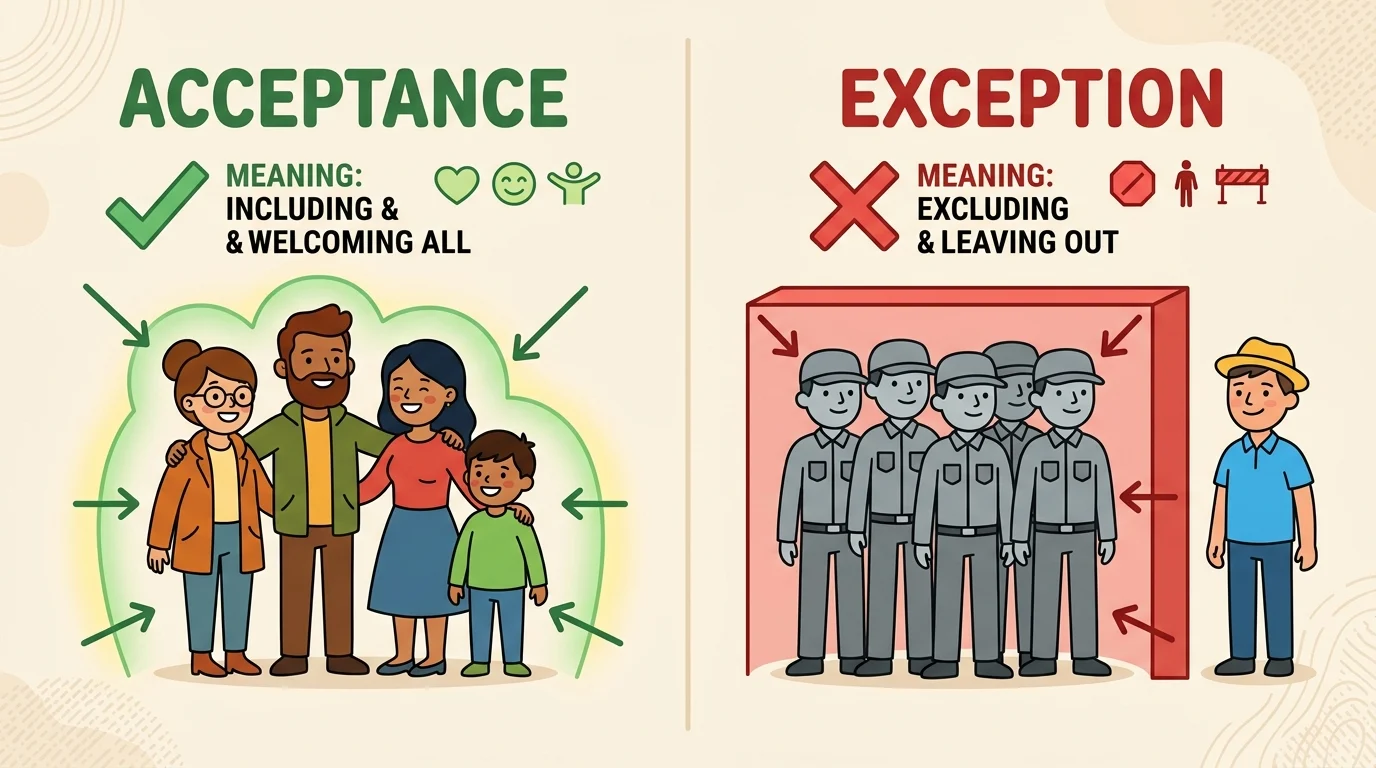
Have you ever typed acception when you meant exception and wondered whether it was actually a real word? You’re not alone. These two terms look remarkably similar, which is why many English learners, students, writers, and even native speakers confuse them.
At first glance, it seems like one might simply be a misspelling of the other. However, the truth is more interesting.
While exception is a common word used in everyday English, acception is a legitimate but uncommon term that survives mainly in linguistics, historical texts, and specialized academic discussions. Understanding the distinction can improve your vocabulary, strengthen your writing skills, and help you avoid a common language mistake.
In this guide, you’ll learn the meaning of each word, their origins, how major dictionaries define them, why people confuse them, and which one you should use in modern English.
Quick Answer
Exception is the correct word in almost all modern English situations. It refers to something that is excluded from a rule, pattern, or general statement.
Acception is a real but rare word that means a particular meaning, interpretation, or sense of a word. It is mostly used in linguistic, philosophical, or historical contexts.
Quick Example
✅ There is one exception to the rule.
❌ There is one acception to the rule.
Featured Snippet Answer
The difference between acception and exception is that exception means something excluded from a rule, while acception refers to a specific meaning or interpretation of a word.
In modern English, exception is common, whereas acception is rare and mainly used in academic or linguistic discussions.
Acception vs Exception at a Glance
| Feature | Acception | Exception |
|---|---|---|
| Part of Speech | Noun | Noun |
| Meaning | A specific meaning or interpretation of a word | Something excluded from a rule |
| Usage Frequency | Rare | Very Common |
| Modern English | Uncommon | Standard |
| Academic Usage | Linguistics and philosophy | All fields |
| Everyday Usage | Rarely used | Frequently used |
| Dictionary Recognition | Yes | Yes |
What Does Exception Mean?
The word exception refers to a person, thing, event, or situation that does not follow a general rule or pattern.
Simple Definition
An exception is something that is excluded from a rule, statement, expectation, or condition.
Examples of Exception
- Every employee must attend the meeting without exception.
- There is one exception to the company policy.
- Most birds can fly, but penguins are an exception.
- The discount applies to all products, with a few exceptions.
In everyday communication, business writing, academic papers, legal documents, and professional correspondence, exception is the word people almost always intend to use.
Common Phrases With Exception
Exception to the Rule
A case that does not follow a general pattern.
Example:
- She succeeds without a college degree, but she is the exception rather than the rule.
Without Exception
Meaning everyone or everything is included.
Example:
- All students must complete the assignment without exception.
Make an Exception
To allow special treatment.
Example:
- The manager agreed to make an exception for the customer.
What Does Acception Mean?
Although many people assume acception is incorrect, it is actually a recognized English word.
Definition of Acception
Acception refers to a specific meaning, interpretation, or sense in which a word or expression is understood.
The term is most commonly found in discussions involving language, semantics, philosophy, theology, and historical literature.
Example of Acception
- The medieval manuscript uses the word in a different acception than modern English.
- Scholars debated the original acception of the term.
- The dictionary records several historical acceptions of the word.
In most modern contexts, writers simply use words such as:
- meaning
- definition
- interpretation
- sense
instead of acception.
Historical Examples of Acception
One reason many people have never encountered acception is that its popularity declined over time.
In earlier centuries, scholars often used the term when discussing language and interpretation.
Example Contexts
- Religious commentary
- Classical philosophy
- Lexicography
- Linguistic studies
- Historical manuscripts
A scholar might write:
The term appears in a broader acception within the original text.
Today, most readers would understand this more easily if written as:
The term appears with a broader meaning within the original text.
Acception vs Exception: Key Differences
Although these words share similar spelling, they serve entirely different purposes.
Acception
- Refers to meaning or interpretation
- Mostly academic
- Rare in everyday English
- Often appears in linguistic discussions
Exception
- Refers to exclusion from a rule
- Common in modern English
- Used across all forms of writing
- Familiar to most readers
Memory Shortcut
Think of:
Acception → Acceptance of a meaning
Exception → Excluded from a rule
This simple association helps many writers remember the difference instantly.
Acception vs Acceptance vs Exception
Another reason for confusion is the word acceptance.
These three terms are related in spelling but differ significantly in meaning.
| Word | Meaning |
|---|---|
| Acception | A meaning or interpretation |
| Acceptance | Approval or willingness to receive something |
| Exception | Something excluded from a rule |
Acceptance Example
- Her acceptance into the university was celebrated.
Acception Example
- The historical acception differs from the modern meaning.
Exception Example
- There is one exception to the policy.
Understanding this distinction helps eliminate one of the most common vocabulary mistakes in English writing.
How Major Dictionaries Define These Words
One of the easiest ways to settle the acception vs exception debate is to look at how respected dictionaries define each term. While all major dictionaries recognize exception, only some include acception, usually marking it as rare, specialized, or historical.
Oxford Definition
According to the Oxford English Dictionary, exception refers to a person or thing that is excluded from a general statement, rule, or pattern.
The dictionary also records acception as a legitimate word, defining it as a particular meaning or sense in which a word is understood. However, it is far less common and appears mainly in scholarly contexts.
Key Takeaway
- Exception = exclusion
- Acception = meaning or interpretation
Merriam-Webster Definition
Merriam-Webster defines exception as someone or something excluded from a general rule.
The dictionary also recognizes acception, describing it as the accepted meaning of a word or expression, though it notes that the term is uncommon in contemporary usage.
Key Takeaway
Modern writers will almost always need exception, not acception.
Cambridge Definition
The dictionaries published by Cambridge University Press focus heavily on modern English usage.
You’ll regularly find extensive entries and examples for exception, while acception appears much less frequently because it has limited relevance in everyday communication.
What This Tells Us
All major dictionaries agree on one important fact:
Acception is real, but exception is the word most people should use.
Is Acception Wrong or Just Rare?
This is one of the most common questions people ask.
Short Answer
Acception is not wrong. It is simply rare.
Many writers assume acception is incorrect because:
- They rarely encounter it.
- Spell-check tools often flag it.
- Most modern style guides avoid it.
- Simpler alternatives exist.
However, rarity does not make a word incorrect.
Think About These Words
Many English words are perfectly valid but uncommon:
- erstwhile
- wherefore
- betwixt
- acception
A word can be grammatically correct while remaining uncommon in everyday communication.
Word Origins and Evolution
Understanding where these words came from makes their meanings easier to remember.
Latin Root of Exception
The word exception originates from the Latin word exceptio.
The root concept involves:
- taking out
- excluding
- removing from a group
This meaning remained remarkably consistent throughout history.
Historical Development
Latin → Old French → Middle English → Modern English
Throughout its evolution, the central idea remained exclusion from a general rule.
Latin Root of Acception
The word acception comes from the Latin word acceptio.
Originally, it referred to:
- receiving
- accepting
- understanding
- interpretation
Over time, scholars began using it to describe the specific sense in which a word was understood.
This specialized meaning eventually became its primary usage.
Why Acception Became Uncommon
Language naturally changes over time.
Several factors caused acception to decline.
Simpler Alternatives Emerged
Writers increasingly preferred:
- meaning
- definition
- interpretation
- sense
These alternatives were easier for readers to understand.
Academic Specialization
Acception gradually became restricted to:
- philosophy
- linguistics
- theology
- lexicography
As a result, ordinary speakers stopped using it.
Modern Communication
Today’s writing values clarity and accessibility.
Most writers avoid obscure vocabulary when a simpler option exists.
Why Linguists Still Use Acception
Although rare, acception remains useful within Linguistics.
Language experts often need a precise way to discuss different meanings of a word.
For example, a single word may have multiple senses.
Example
The word “bank” can mean:
- a financial institution
- the side of a river
A linguist may refer to these as different acceptions of the same word.
In everyday writing, people would simply call them different meanings.
However, academic researchers sometimes prefer the more technical term.
Which Word Is More Common in Modern English?
There is no contest here.
Exception is dramatically more common than acception.
You will encounter exception in:
- newspapers
- websites
- books
- legal documents
- business communication
- academic writing
- social media
By contrast, acception appears mostly in:
- historical texts
- scholarly papers
- linguistic studies
- specialized dictionaries
Practical Rule
If you are writing for general readers, choose exception.
If you are discussing the meaning of words in a scholarly context, acception may be appropriate.
Why People Confuse Acception and Exception
The confusion is understandable because these words share several characteristics.
Similar Spelling
Compare them closely:
- Acception
- Exception
Only a few letters differ.
Many readers overlook these differences when reading quickly.
Similar Pronunciation
Depending on accent and speech patterns, the words may sound somewhat alike.
This increases the likelihood of writing one when you mean the other.
Confusion With Acceptance
Many people are already familiar with:
- accept
- accepted
- acceptance
Because acception resembles these words, writers sometimes assume it carries a similar meaning.
This overlap creates additional confusion.
Spell-Checker Dependence
Modern writers often rely on spell-check software.
When a tool flags acception, users frequently conclude the word must be incorrect.
In reality, some spell-check systems simply treat it as too uncommon to recommend.
Why This Distinction Matters
At first glance, mixing up these words may seem harmless.
However, incorrect word choice can affect:
- academic credibility
- professional communication
- business writing
- educational materials
- published content
Consider the difference:
❌ There is one acception to the policy.
✅ There is one exception to the policy.
The first sentence sounds confusing because the wrong word changes the intended meaning.
Precise vocabulary improves clarity and professionalism.
Should You Use Acception or Exception?
The correct choice depends on what you want to express. Although these words look similar, they serve very different purposes in English. Understanding the context will help you choose the right one every time.
Use Exception When
Use exception when referring to something that is excluded from a rule, does not follow a general pattern, or is treated as a special case.
You mean:
- An exclusion
- A special case
- A rule that does not apply
Examples:
✅ There is one exception to the rule.
✅ We made an exception for the guest.
✅ Everyone attended without exception.
For most everyday, professional, academic, and business writing, exception is the correct choice.
Use Acception When
Use acception when discussing the meaning, interpretation, or specific sense of a word. This usage is uncommon and mainly appears in linguistic, philosophical, or historical contexts.
You mean:
- A meaning
- An interpretation
- A specific sense of a word
Examples:
✅ The historical acception differs from the modern one.
✅ The scholar explained the original acception of the phrase.
Because the word is rare, most writers will never need to use it outside specialized discussions.
If You Are Writing for General Readers
When writing for a broad audience, it is usually better to replace acception with simpler alternatives that readers immediately understand.
Better alternatives include:
- Meaning
- Definition
- Interpretation
These words are clearer, more familiar, and more effective in modern communication.
If You Are Writing Academic Content
In scholarly writing, acception may still be useful when discussing language, semantics, or historical meanings with precision.
Common areas where the term appears include:
- Semantics
- Lexical meaning
- Historical language usage
- Philosophy of language
In these specialized fields, the technical distinction can be important and may justify using acception instead of more general alternatives.
Common Mistakes People Make
Even after understanding the definitions, many writers still confuse acception and exception because the words look and sound similar. Here are the most common mistakes and how to avoid them.
Using Acception Instead of Exception
This is the most frequent error. Since exception is the word used for something excluded from a rule, replacing it with acception changes the meaning completely.
Incorrect:
❌ There is one acception to the company policy.
Correct:
✅ There is one exception to the company policy.
In this sentence, the writer is referring to a rule and an exclusion, so exception is the correct choice.
Assuming Acception Is a Misspelling
Many people believe that acception is simply a spelling mistake because they rarely encounter it in modern English.
Incorrect Assumption:
❌ Acception is not a real word.
Correct Understanding:
✅ Acception is a legitimate but uncommon English word that refers to a particular meaning or interpretation of a term.
Although rare, it still appears in linguistic, philosophical, and historical discussions.
Using Exception to Mean Definition
Because exception is far more common, some writers mistakenly use it when discussing the meaning of a word.
Incorrect:
❌ The exception of the word has changed over time.
Correct:
✅ The meaning of the word has changed over time.
✅ The acception of the word has changed over time.
While the second sentence is technically correct, most modern readers will understand meaning more easily than acception.
Confusing Acceptance and Acception
Another common mistake is mixing up acceptance and acception. Although the words look similar, their meanings are completely different.
Acceptance refers to approval, agreement, or willingness to receive something.
Acception refers to a specific meaning or interpretation of a word.
Incorrect:
❌ Her acception into the university was exciting.
Correct:
✅ Her acceptance into the university was exciting.
When talking about admission, approval, or agreement, always use acceptance, not acception.
Real-World Usage Examples
Seeing words in context is one of the best ways to remember them.
In Business Writing
Business communication almost always uses exception.
Examples
- We cannot grant exceptions to this policy.
- The manager approved an exception for the client.
- The refund policy applies without exception.
You will rarely, if ever, see acception in business documents.
In Academic Writing
Academic writing may use either word depending on the subject.
Exception Example
- This study represents an exception to previous findings.
Acception Example
- The term acquired a broader acception during the eighteenth century.
Researchers in language-related fields occasionally use acception because it provides technical precision.
In Historical Studies
Historians and literary scholars are more likely to encounter acception.
Example
- The original acception of the phrase differs from its modern interpretation.
Older texts often preserve meanings that have changed over time.
In Everyday Conversation
Almost everyone uses exception.
Examples
- Everyone came except Tom.
- There is one exception.
- We made an exception this time.
Most native speakers never use acception in casual speech.
Practice Quiz
Test your understanding.
Fill in the Blanks
Question 1
There is one ______ to the dress code.
A. Acception
B. Exception
Question 2
The scholar discussed an older ______ of the term.
A. Acception
B. Exception
Question 3
All employees must follow the rule without ______.
A. Acception
B. Exception
Question 4
The dictionary lists several historical ______ of the word.
A. Acceptions
B. Exceptions
Question 5
Most birds can fly, with a few ______.
A. Acceptions
B. Exceptions
Answers
Question 1
✅ Exception
Question 2
✅ Acception
Question 3
✅ Exception
Question 4
✅ Acceptions
Question 5
✅ Exceptions
If you answered all five correctly, you now understand the distinction better than most writers.
FAQs
Is Acception a Real Word?
Yes. Acception is a legitimate English word that refers to a particular meaning or interpretation of a term. However, it is uncommon and primarily used in linguistic, philosophical, and historical contexts.
Which Is Correct: Acception or Exception?
In most situations, exception is the correct choice. Acception is only appropriate when discussing the meaning or sense of a word.
What Is the Difference Between Acception and Exception?
Exception means something excluded from a rule, while acception refers to a specific meaning or interpretation of a word.
Is Acception Obsolete?
Not completely. The word still appears in academic and linguistic writing, although it is rare in everyday English.
Why Does My Spell Checker Flag Acception?
Many spell-check systems prioritize common modern vocabulary. Because acception is rarely used, some tools may incorrectly suggest replacing it with exception.
Can I Use Acception Instead of Exception?
No. The two words have different meanings and cannot usually replace each other.
Which Word Is More Common?
Exception is significantly more common in modern English and appears across nearly every form of communication.
What Does “Exception to the Rule” Mean?
An exception to the rule is a person, thing, or situation that does not follow a general pattern or standard.
Should I Use Acception in SEO Writing?
Generally no. Most readers search for and understand words like meaning, definition, and interpretation more easily. Unless your topic specifically involves linguistics or historical language usage, acception is usually unnecessary.
Final Verdict
When comparing acception and exception, the distinction is straightforward once you understand their meanings. Exception is the word used throughout modern English to describe something excluded from a rule, pattern, or expectation.
It appears in everyday conversations, business communication, academic writing, legal documents, and professional correspondence. In contrast, acception is a legitimate but highly specialized term that refers to a particular meaning or interpretation of a word.
Although both words share similar spelling and historical roots, they serve entirely different purposes. For most writers, students, and professionals, exception is the correct choice nearly every time.
Reserve acception for discussions involving language, semantics, historical texts, or scholarly analysis.
Remembering this distinction will help you write more clearly, avoid common vocabulary mistakes, and communicate with greater precision and confidence.
Related Blogs:

Hi, I am Constance Hale, an author featured on Grammerdesk.com. I focus on language, writing style, and grammar, helping readers improve clarity, expression, and effective communication in English.