Have you ever written greatful and then wondered whether it was actually correct? You are not alone. This is one of the most common English spelling mistakes because both words look believable at first glance.
Many students, writers, and English learners get confused between greatful or grateful, especially since the word great seems closely related to feelings of appreciation. The good news is that the rule is simple once you understand it.
In this guide, you’ll learn the correct spelling, why the confusion happens, examples of proper usage, and an easy trick to remember the right form every time.
Quick Answer
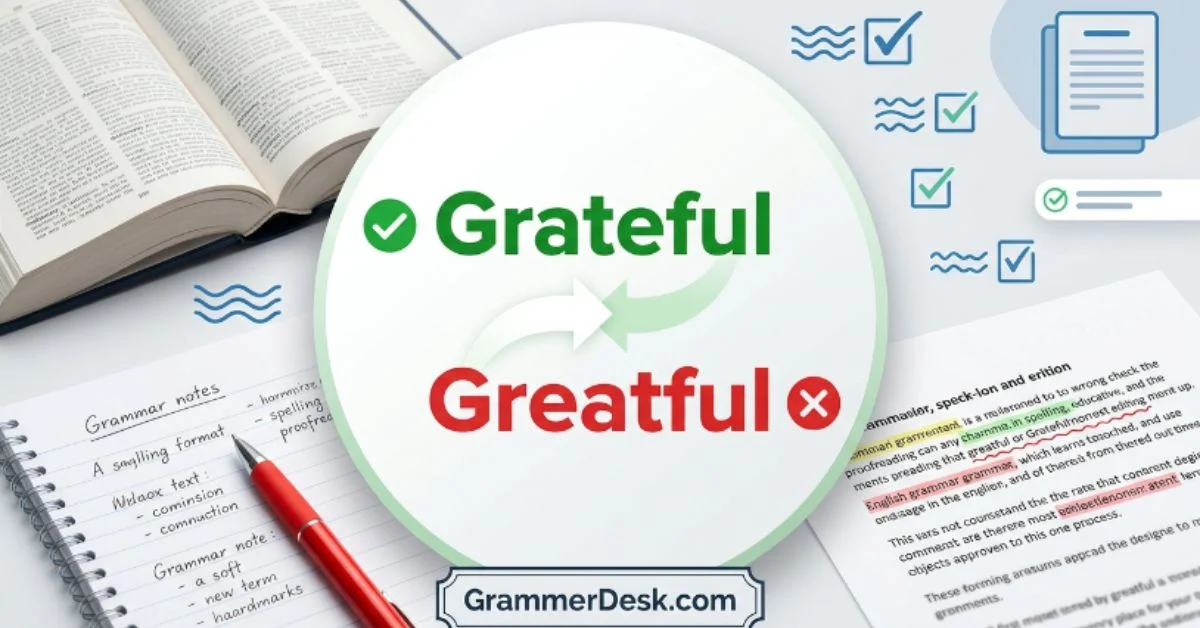
The correct spelling is grateful.
❌ Greatful is incorrect and is considered a spelling mistake.
✅ Grateful means feeling thankful, appreciative, or thankful for someone’s kindness.
Example:
- I am grateful for your support.
- She felt grateful after receiving help.
If you’re choosing between greatful or grateful, always use grateful.
Why Do People Confuse Greatful and Grateful?
The confusion happens because many people associate feelings of appreciation with something great.
As a result, they mistakenly assume the word should be spelled greatful. However, English spelling does not work that way in this case.
The correct word comes from the idea of gratitude, not from the word great.
Notice the connection:
- Gratitude
- Grateful
- Gratefully
- Gratefulness
All these words share the same root related to thankfulness and appreciation.
Greatful vs Grateful: Comparison Table
| Feature | Grateful | Greatful |
|---|---|---|
| Correct English spelling | ✅ Yes | ❌ No |
| Found in dictionaries | ✅ Yes | ❌ No |
| Means thankful or appreciative | ✅ Yes | ❌ No |
| Appropriate in formal writing | ✅ Yes | ❌ No |
| Common spelling mistake | ❌ No | ✅ Yes |
Winner: Always use grateful.
Which One Should You Use?
You should use grateful in every situation where you want to express thankfulness, appreciation, or recognition for help, kindness, or support.
Correct Examples
- I am grateful for your advice.
- We are grateful for the opportunity.
- She felt grateful after the interview.
- They were grateful for everyone’s assistance.
- I’m deeply grateful for your generosity.
Incorrect Examples
- ❌ I am greatful for your advice.
- ❌ She felt greatful after the interview.
- ❌ We are greatful for your help.
In every example above, grateful is the correct choice.
Real-World Usage Examples
Here are some natural sentences showing how native English speakers use grateful.
- I am grateful for everything you have done.
- The family was grateful for the community’s support.
- We are grateful to our customers for their trust.
- She sent a grateful message after receiving the gift.
- He remained grateful throughout his career.
These examples show how the adjective grateful commonly appears in everyday English, academic writing, and professional communication.
Common Mistakes to Avoid
Many writers make these errors:
Using “greatful” in formal writing
Because spell-check tools sometimes miss certain typing errors, writers may accidentally leave greatful in emails, essays, or reports.
Assuming it comes from “great”
Although the words sound somewhat related in meaning, grateful is connected to gratitude, not great.
Ignoring proofreading
A quick proofreading pass can help catch spelling errors like:
- Greatful → Grateful
- Definately → Definitely
- Recieve → Receive
- Loose → Lose
How to Pronounce Grateful
The word grateful is pronounced as:
/ˈɡreɪt.fəl/
It sounds very similar to the word great, which is one reason many people mistakenly write greatful.
However, pronunciation does not always determine spelling in English. Even though the first syllable sounds like great, the correct spelling remains grateful because the word is connected to gratitude.
Listening to native English speakers and seeing the word used in context can help reinforce the correct spelling.
Grateful Meaning and Synonyms
Grateful is an adjective that describes a feeling of thankfulness, appreciation, or recognition for kindness, help, or support received from someone.
Synonyms of Grateful
Depending on the context, you can use:
- Thankful
- Appreciative
- Obliged
- Indebted
- Recognizing
- Appreciative of
Examples
- We are grateful for your generosity.
- She was grateful for the opportunity to learn.
- I am deeply grateful for your guidance.
While these synonyms have similar meanings, grateful is often the most natural choice when expressing sincere appreciation.
A Simple Memory Trick
Remember this phrase:
Gratitude creates Grateful.
Both words begin with “grat-“.
If you can spell gratitude, you can easily remember how to spell grateful.
Another quick reminder:
❌ Great → Greatful
✅ Gratitude → Grateful
This trick helps many English learners avoid the mistake permanently.
Related Words Readers May Also Confuse
If you struggle with greatful or grateful, you may also encounter similar grammar and spelling questions:
- Thankful vs Grateful
- Accept vs Except
- Affect vs Effect
- Then vs Than
- Loose vs Lose
- Your vs You’re
- Its vs It’s
- Principal vs Principle
These word pairs often cause confusion because they sound similar or look alike.
FAQs
Is greatful a real word?
No. Greatful is not recognized as a standard English word. It is considered a misspelling of grateful.
Why is grateful spelled without “e”?
The word comes from gratitude, which uses the root grat-. That is why the correct spelling is grateful, not greatful.
What does grateful mean?
Grateful means feeling thankful, appreciative, or pleased because of someone’s kindness, help, or support.
Is grateful an adjective?
Yes. Grateful is an adjective used to describe a person’s feeling of appreciation or thankfulness.
What is the noun form of grateful?
The related noun is gratitude, which means thankfulness or appreciation.
Can I use grateful in professional emails?
Yes. It is commonly used in professional communication.
Example: I am grateful for your time and consideration.
What is the difference between thankful and grateful?
Both express appreciation. However, grateful often suggests a deeper sense of appreciation, while thankful is commonly used for general expressions of thanks.
Conclusion
When choosing between greatful or grateful, the correct spelling is always grateful. The word is related to gratitude, which makes the spelling easier to remember. While greatful may seem logical because of the word great, it is not accepted in standard English.
The simplest rule is this: if you want to express thankfulness or appreciation, use grateful. Remember the connection between gratitude and grateful, and you’ll avoid this common spelling mistake with confidence every time.
Discover More Blogs:

Hi, I am Constance Hale, an author featured on Grammerdesk.com. I focus on language, writing style, and grammar, helping readers improve clarity, expression, and effective communication in English.