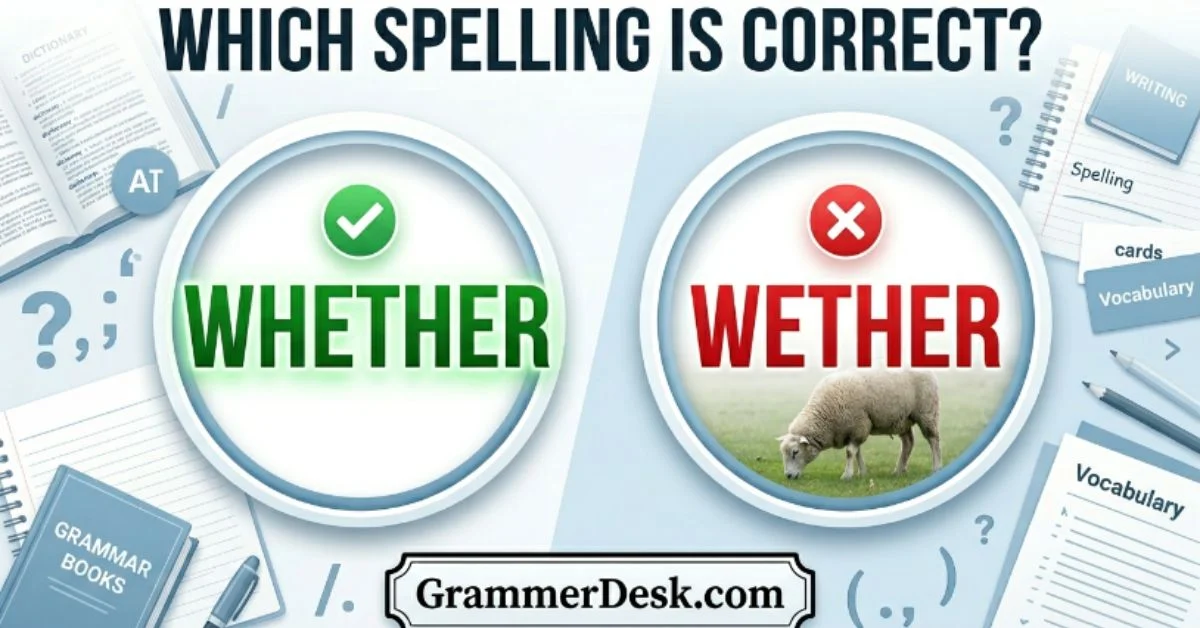
Many English learners and writers get confused between whether and wether because the words look almost identical.
However, they have completely different meanings. In most cases, the correct word is whether, which is used to express choices, alternatives, or uncertainty.
Meanwhile, wether is a farming term that refers to a castrated male sheep. Understanding the difference can help you avoid a common spelling mistake and improve your writing.
This guide explains the meanings, usage, examples, and grammar rules behind these commonly confused words.
Quick Answer
Whether is the correct spelling when you are talking about a choice, condition, alternative, or uncertainty.
Wether is a real English word, but it refers to a castrated male sheep and is rarely used outside agriculture and livestock discussions.
Correct Example
- I do not know whether he will come.
- She asked whether the meeting was canceled.
- We must decide whether to stay or leave.
Incorrect Example
- I do not know wether he will come. ❌
- Tell me wether you agree. ❌
- We are unsure wether the plan will work. ❌
What Does Whether Mean?
Common Meanings
The word whether is a subordinating conjunction that introduces alternatives, choices, conditions, or indirect questions.
Writers commonly use it when discussing uncertainty or presenting two possibilities.
Examples:
- I wonder whether it will rain today.
- Tell me whether you accept the offer.
- We have not decided whether to move.
Simple Usage Examples
- Whether you agree or disagree, your opinion matters.
- She was unsure whether the information was correct.
- They debated whether the project should continue.
What Does Wether Mean?
Definition of Wether
A wether is a castrated male sheep. The term is mainly used in farming, agriculture, and animal husbandry.
Most people never use this word in everyday writing, which is why it is often mistaken for whether.
Simple Usage Examples
- The farmer sold a wether at the livestock market.
- The wether grazed with the rest of the flock.
- The field contained several ewes, rams, and one wether.
The Origin of Whether and Wether
Word History
The word whether comes from Old English hwæther, meaning “which of two” or “which alternative.”
The word wether also has Old English roots but developed as a livestock term referring to a male sheep.
Although the words share historical origins, their meanings evolved in very different directions.
Why the Confusion Happens
People confuse these words because:
- They differ by only one letter.
- Their pronunciation is similar.
- Both words exist in English dictionaries.
- Most writers are unfamiliar with the farming term wether.
As a result, many spelling mistakes occur when writers accidentally replace whether with wether.
British English vs American English
Unlike words such as colour/color or maximise/maximize, there is no spelling difference between British and American English.
Comparison Table
| Usage | British English | American English |
|---|---|---|
| Whether | Correct | Correct |
| Wether (sheep) | Correct | Correct |
| Alternative spelling of whether | None | None |
Both regions use the same spelling and grammar rules.
Whether vs Wether
Spelling Comparison Table
| Word | Correct? | Meaning | Usage |
|---|---|---|---|
| Whether | Yes | Choice, alternative, uncertainty | Common |
| Wether | Yes | Castrated male sheep | Rare |
| Wether (instead of whether) | No | Misspelling | Incorrect |
| Wheather | No | Misspelling | Incorrect |
Which Spelling Should You Use?
Writing Rule
If your sentence involves:
- uncertainty
- alternatives
- decisions
- indirect questions
- conditions
use whether.
Examples:
- I am not sure whether she called.
- Tell me whether you agree.
- We need to know whether the event is still scheduled.
Use wether only when discussing sheep or livestock.
Examples:
- The wether remained in the pasture.
- Farmers often separate the wether from breeding rams.
How to Remember the Difference
Easy Memory Trick
A simple trick is to connect whether with the word choice.
Whenever you are choosing between options, whether is almost always correct.
Example:
- Whether to stay or leave.
- Whether it rains or shines.
Think of wether as a farm word.
If your sentence is not about a sheep, you probably need whether.
Common Mistakes with Whether and Wether
Frequent Errors
Many writers accidentally type wether when they mean whether.
Common mistakes include:
- Using wether in emails
- Using wether in essays
- Using wether in business documents
- Using wether in social media posts
Corrected Examples
| Incorrect | Correct |
|---|---|
| Let me know wether you agree. | Let me know whether you agree. |
| I wonder wether he arrived. | I wonder whether he arrived. |
| Tell me wether it is true. | Tell me whether it is true. |
| We discussed wether to continue. | We discussed whether to continue. |
Whether in Everyday Examples
Emails
- Please confirm whether you can attend the meeting.
- Let us know whether the documents were received.
News Writing
- Officials are evaluating whether new measures are necessary.
- Experts remain uncertain whether prices will rise.
School Writing
- Students discussed whether technology improves education.
- The essay examined whether social media affects learning.
Business Writing
- Management will decide whether to approve the proposal.
- The company is considering whether to expand operations.
Related Grammar Rules
Whether vs If
Many writers also confuse whether and if.
Both can introduce indirect questions, but whether is usually preferred when presenting alternatives.
Examples:
- I do not know whether he is coming. ✅
- I do not know if he is coming. ✅
When explicit alternatives exist, whether is often the better choice.
Example:
- We must decide whether to stay or leave. ✅
Helpful Grammar Tips
- Use whether for alternatives and uncertainty.
- Use wether only for sheep-related contexts.
- Proofread carefully because spell-check may not catch the mistake.
- Remember that both words are valid English words but have different meanings.
FAQs
Is whether or wether correct?
Whether is correct when expressing alternatives, uncertainty, or choices. Wether is a sheep-related noun.
Is wether a real word?
Yes. A wether is a castrated male sheep used in livestock farming.
What is the difference between whether and wether?
Whether is a conjunction used in grammar, while wether is a noun referring to a sheep.
Why do people misspell whether as wether?
The words look similar, sound similar, and differ by only one letter.
Can wether replace whether?
No. Using wether instead of whether creates a spelling mistake unless you are talking about sheep.
Is whether used in formal writing?
Yes. Whether is widely used in academic, legal, business, and professional writing.
Does British English spell whether differently?
No. British and American English use the same spelling.
How can I remember whether vs wether?
Remember that whether relates to choices and uncertainty, while wether is a farm animal term.
Conclusion
The difference between whether and wether is easy to remember once you know their meanings.
Whether is the correct word for expressing choices, alternatives, conditions, and uncertainty. Wether, on the other hand, is a livestock term that refers to a castrated male sheep.
Since both words are valid English words, many writers accidentally use the wrong spelling. To avoid mistakes, remember that unless you are writing about sheep farming, you almost certainly need whether.
Using the correct spelling will make your writing clearer, more professional, and grammatically accurate.

Hi, I am Constance Hale, an author featured on Grammerdesk.com. I focus on language, writing style, and grammar, helping readers improve clarity, expression, and effective communication in English.