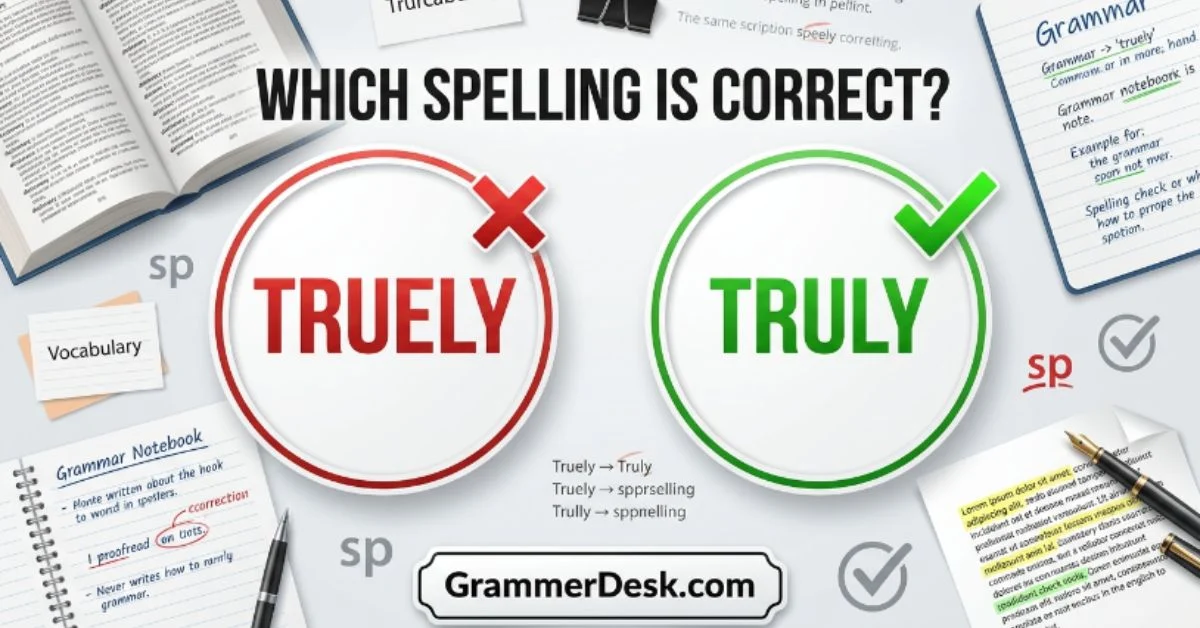
Have you ever typed truely and wondered if it was correct? You are not alone. Many English writers make this mistake because the spelling seems logical.
After all, the adjective true ends with the letter e. However, English spelling rules work differently in this case.
The correct spelling is truly, not truely. Understanding this small rule can help you avoid a common writing error and improve your grammar.
This guide explains the correct spelling, the reason behind it, and how to use truly confidently in everyday writing.
Quick Answer
Truly is the correct spelling.
Truely is a misspelling and is not accepted in standard English.
When the adjective true becomes an adverb, the final e is dropped before adding -ly, creating truly.
Correct Example
- I truly appreciate your help.
- She is truly talented.
- We are truly grateful for your support.
Incorrect Example
- I truely appreciate your help. ❌
- She is truely talented. ❌
- We are truely grateful. ❌
What Does Truly Mean?
Common Meanings
Truly is an adverb that means:
- Honestly
- Sincerely
- Genuinely
- Really
- Certainly
- Faithfully
It is used to emphasize that something is true, genuine, or heartfelt.
Simple Usage Examples
- I truly believe this is the right decision.
- He was truly surprised by the news.
- We truly enjoyed our vacation.
- She is truly dedicated to her work.
- This was a truly unforgettable experience.
Why Is “Truly” Correct and “Truely” Incorrect?
The Grammar Rule
Many English adverbs are formed by adding -ly to an adjective.
However, when the adjective true becomes an adverb, the final e is removed before adding -ly.
Word formation:
| Adjective | Adverb |
|---|---|
| True | Truly |
This spelling follows a long-established English convention.
Why Writers Get Confused
People often write truely because:
- The base word ends in e.
- The spelling appears more logical at first glance.
- Similar words sometimes keep the e before adding a suffix.
Because of this, truely has become a very common spelling mistake.
The Origin of Truly
Word History
The word truly comes from the adjective true, which has roots in Old English.
For centuries, English speakers have used truly as the standard adverb form. Dictionaries, style guides, and grammar references consistently recognize truly as the correct spelling.
Why the Final E Disappears
English spelling does not always follow one simple pattern.
In the case of true, the language evolved so that the final e is dropped before adding -ly.
This is why we write:
- True → Truly ✅
and not:
- True → Truely ❌
British English vs American English
Unlike words such as colour/color or maximise/maximize, there is no regional spelling difference here.
Comparison Table
| Usage | British English | American English |
|---|---|---|
| Truly | Correct | Correct |
| Truely | Incorrect | Incorrect |
Both British and American English use truly.
Truly vs Truely
Spelling Comparison Table
| Word | Correct? | Meaning |
|---|---|---|
| Truly | Yes | Honestly, genuinely, sincerely |
| Truely | No | Misspelling |
| Truly Yours | Correct Expression | Formal closing phrase |
| Truely Yours | Incorrect Expression | Spelling error |
The only correct standard spelling is truly.
Which Spelling Should You Use?
Standard Writing Rule
Use truly in all forms of writing, including:
- Academic writing
- Business communication
- Emails
- Articles
- Social media posts
- Professional documents
Avoid truely because it is considered a spelling mistake.
Examples:
- I truly understand your concern.
- We truly appreciate your patience.
- She truly deserves recognition.
How to Remember the Difference
Easy Memory Trick
Think of this simple formula:
True + Ly = Truly
Remember that the e disappears before adding -ly.
Whenever you feel tempted to write truely, pause and remember:
The correct adverb form drops the final e.
Quick Test
Ask yourself:
“Am I trying to say honestly, genuinely, or sincerely?”
If yes, use truly.
Common Mistakes with Truly
Frequent Errors
Writers often make mistakes such as:
- Adding an unnecessary e
- Writing truely yours
- Using truely in formal documents
- Assuming the base spelling remains unchanged
Corrected Examples
| Incorrect | Correct |
|---|---|
| I truely agree. | I truly agree. |
| We are truely thankful. | We are truly thankful. |
| Yours truely | Yours truly |
| She was truely excited. | She was truly excited. |
Truly in Everyday Examples
Emails
- We truly appreciate your feedback.
- I truly value your time and effort.
Social Media
- I truly loved this movie.
- We are truly excited about the launch.
News Writing
- Officials are truly concerned about the situation.
- Experts truly believe the policy will help.
School Writing
- The student truly understood the concept.
- The research was truly informative.
Business Writing
- We truly appreciate your continued partnership.
- The company is truly committed to quality service.
Related Grammar Rules
Adjective to Adverb Formation
Many adverbs are created by adding -ly to adjectives.
Examples:
| Adjective | Adverb |
|---|---|
| Quick | Quickly |
| Slow | Slowly |
| Happy | Happily |
| Simple | Simply |
| True | Truly |
Understanding this pattern helps improve spelling accuracy.
Similar Word Formation Examples
Several English words also change slightly when suffixes are added:
| Base Word | Correct Form |
|---|---|
| True | Truly |
| Due | Duly |
| Whole | Wholly |
| Gentle | Gently |
| Simple | Simply |
These examples show that English spelling often changes during word formation.
FAQs
Is it truely or truly?
Truly is correct. Truely is a misspelling.
Why is truly spelled without an e?
English spelling rules drop the final e from true before adding -ly.
Is truely a real word?
No. Standard English dictionaries do not recognize truely as a correct spelling.
What does truly mean?
Truly means honestly, sincerely, genuinely, really, or certainly.
How do you use truly in a sentence?
Example: I truly appreciate your support.
Is truly an adverb?
Yes. Truly is an adverb formed from the adjective true.
Is “Yours truly” correct?
Yes. Yours truly is a standard phrase often used in letters and emails.
Do British and American English spell truly differently?
No. Both use the same spelling: truly.
Conclusion
The answer is simple: truly is correct, while truely is incorrect. Although many people assume the adverb should keep the final e from true, standard English removes it before adding -ly.
As a result, truly is the only accepted spelling in academic, professional, and everyday writing. Remember the simple rule True + Ly = Truly whenever you are unsure.
By learning this common spelling pattern, you can avoid mistakes, write with greater confidence, and improve the overall quality of your English communication.
Read More Blogs:
Leafs or Leaves? The Correct Word Explained With Easy Examples

Hi, I’m Gerald Graff, a writer at GrammerDesk.com. I create simple, practical guides on English grammar, confusing words, homophones, spelling, and common language mistakes to help readers write and communicate with confidence.