Have you ever paused while writing and wondered whether it should be “potatoes” or “potatos”? This is one of the most common spelling doubts in English, especially among English learners, ESL learners, students, and content writers.
Since many English words simply add “s” to form plurals, it feels natural to write potatos. However, standard English usage follows different pluralization rules for certain nouns.
The confusion comes from English spelling rules and word formation patterns for English words ending in -o. Some nouns take only -s, while others require the suffix -es.
Because of this inconsistency, people often make spelling mistakes in recipes, academic writing, food blogs, emails, and other forms of written communication.
In this guide, you’ll learn the correct spelling, pronunciation, grammar rule, history, word usage, and real-life examples of potatoes.
You’ll also understand the pluralization rule behind the word, making potato spelling in English much easier and improving your overall language learning skills.
Quick Answer
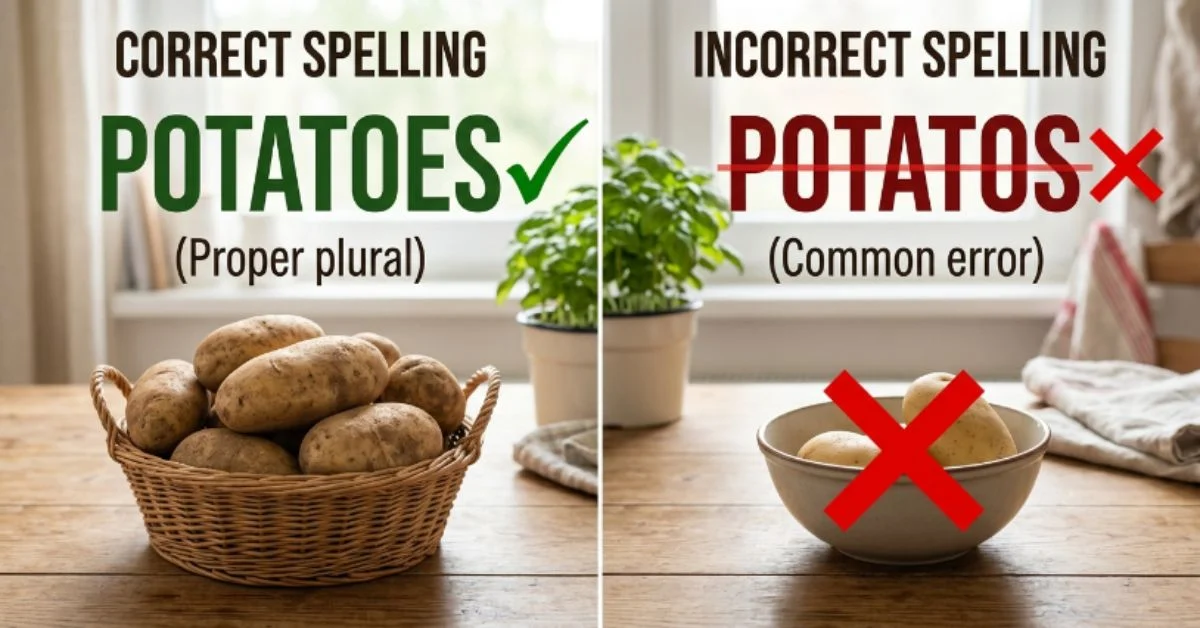
The correct spelling is potatoes.
“Potatos” is incorrect in standard English.
| Word | Correct? | Meaning |
|---|---|---|
| Potatoes | Yes | More than one potato |
| Potatos | No | Spelling mistake |
Examples
✔ I bought fresh potatoes from the market.
✔ Mashed potatoes are my favorite dish.
✘ I bought fresh potatos from the market.
The correct plural of potato is always potatoes.
Pronunciation of Potatoes or Potatos
The correct pronunciation of potatoes is:
puh-TAY-tohz
Phonetic form:
/pəˈteɪtoʊz/
Spoken Breakdown
- Potato → puh-TAY-toh
- Potatoes → puh-TAY-tohz
Important Note
Even though potatos looks different in spelling, it is not used in standard writing. In speech, both would sound the same, but grammar rules decide correctness.
Example Usage
- I like boiled potatoes with salt.
- The farmers harvested large potatoes this season.
- Mashed potatoes are a global food staple.
Why People Confuse Potatoes or Potatos
This confusion happens because English pluralization rules are not always consistent.
Many learners assume that every noun simply adds -s to become plural:
- Dog → Dogs
- Car → Cars
- Potato → Potatos (incorrect assumption)
However, English words ending in -o follow different word formation patterns. Some nouns add only -s, while others require the suffix -es.
| Rule Type | Example |
|---|---|
| Add -s | photo → photos |
| Add -es | potato → potatoes |
| Both accepted (rare cases) | volcano → volcanos / volcanoes |
People commonly make this mistake because of:
- Overgeneralizing the “add S” rule
- Limited exposure to correct English usage
- Influence of spoken English
- Similar vocabulary patterns
- Confusion during language learning
Example:
✘ I ate fried potatos.
✔ I ate fried potatoes.
Learning this simple pluralization pattern makes potato singular and plural examples much easier to understand and helps you avoid one of the most common English spelling mistakes.
Easy Trick to Remember Potatoes or Potatos
Here is a simple memory trick:
The “ES Food Rule”
Most common food words ending in “o” use -es.
Think:
“Potatoes need extra care, so they get ES.”
Memory Formula
- Potato → Potatoes (always ES)
- Tomato → Tomatoes (same rule)
Quick Tip
If it’s a common vegetable:
👉 Add “ES”, not just “S”
The Origin of Potatoes or Potatos
Word Origin
The word potato comes from the Spanish word “patata”, which originally referred to a mix of sweet potato and potato.
It entered English in the 16th century during exploration and trade.
Historical Spread
- Native to South America
- Introduced to Europe by explorers
- Became a global staple food
Why Plural Became “Potatoes”
English adopted a rule where many nouns ending in -o take -es for easier pronunciation and standardization.
This is why we say:
- potato → potatoes
- tomato → tomatoes
British English vs American English Spelling
Unlike some words, potatoes does NOT change between British and American English.
Comparison Table
| Meaning | British English | American English |
|---|---|---|
| Singular | potato | potato |
| Plural | potatoes | potatoes |
Examples
UK English:
- The potatoes are boiling.
US English:
- The potatoes are boiling.
Both follow the same spelling rule globally.
Which Spelling Should You Use?
The answer is simple.
Always Use “Potatoes”
Use it in:
- Academic writing
- Cooking blogs
- Recipes
- Emails
- News articles
- Restaurant menus
- Food packaging
Never Use “Potatos”
The spelling potatos is considered:
- Incorrect
- Non-standard
- A spelling error
Professional Advice
Whether you’re writing SEO content, academic assignments, business emails, recipes, or professional documents, always use potatoes.
Every major English dictionary recognizes potatoes as the correct plural spelling. In standard English usage, the spelling potatos is considered incorrect. Using the correct form improves your grammar, vocabulary, and overall written communication in both formal English and everyday English.
Common Mistakes with Potatoes or Potatos
Mistake #1
✘ I like potatos with curry
✔ I like potatoes with curry
Mistake #2
✘ Boiled potatos are healthy
✔ Boiled potatoes are healthy
Mistake #3
✘ The farm grows potatos
✔ The farm grows potatoes
Mistake #4
✘ Potatos are rich in starch
✔ Potatoes are rich in starch
Mistake #5
Wrong assumption:
- All words ending in O just take S
Correct rule:
- Some take ES, like potatoes and tomatoes
Potatoes or Potatos in Everyday Examples
Emails
✔ Please include boiled potatoes in the lunch menu.
News Writing
✔ Potato production has increased this year.
Social Media
✔ Homemade fries with crispy potatoes tonight!
Recipes
✔ Ingredients: potatoes, salt, oil, spices.
Academic Writing
✔ Potatoes are a major agricultural crop worldwide.
Restaurant Menus
✔ Mashed potatoes served with grilled chicken.
Farming Reports
✔ Potatoes are harvested in large quantities during winter season.
Potatoes or Potatos – Google Trends & Usage Data
Global Usage Insight
Search data shows:
- “potatoes” dominates globally
- “potatos” is mostly searched as a correction query
Why People Search “Potatos”
Users often search:
- Is potatos correct?
- Potatoes or potatos spelling
- Why potatoes ends with es
High-Interest Regions
- United States
- United Kingdom
- India
- Pakistan
- Australia
Usage Context
The word potatoes appears heavily in:
- Food blogs
- Recipes
- Agriculture content
- Nutrition articles
- Restaurant menus
Potatoes vs Potatos Comparison Table
| Feature | Potatoes | Potatos |
|---|---|---|
| Correct spelling | Yes | No |
| Dictionary accepted | Yes | No |
| Used in recipes | Yes | No |
| Used in writing | Yes | No |
| Grammar standard | Yes | No |
| Meaning clarity | Clear | Incorrect form |
FAQs
Is potatos correct spelling?
No. The correct spelling is potatoes.
What is the plural of potato?
The plural form is potatoes.
Why is it potatoes and not potatos?
Because nouns ending in “o” often take -es in English grammar.
Is potatoes British or American English?
It is used in both British and American English.
How do you spell potatoes correctly?
P-O-T-A-T-O-E-S
Are potatoes countable or uncountable?
Potatoes are countable nouns.
What are potatoes used for?
They are used in:
- Cooking
- Farming
- Food production
- Nutrition
Conclusion
The correct spelling is clearly potatoes, not potatos. This confusion comes from English spelling rules for nouns ending in “o,” where some words add “s” and others add “es.” Since potato follows the “add ES” rule, the correct plural becomes potatoes.
This word is widely used in cooking, farming, academic writing, and everyday communication. Understanding this rule helps avoid common spelling mistakes and improves writing accuracy.
Whether you are writing recipes, emails, or academic content, always choose the correct form: potatoes. With practice, this rule becomes easy and natural for all English learners.
Related Posts:

Hi, I am Constance Hale, an author featured on Grammerdesk.com. I focus on language, writing style, and grammar, helping readers improve clarity, expression, and effective communication in English.