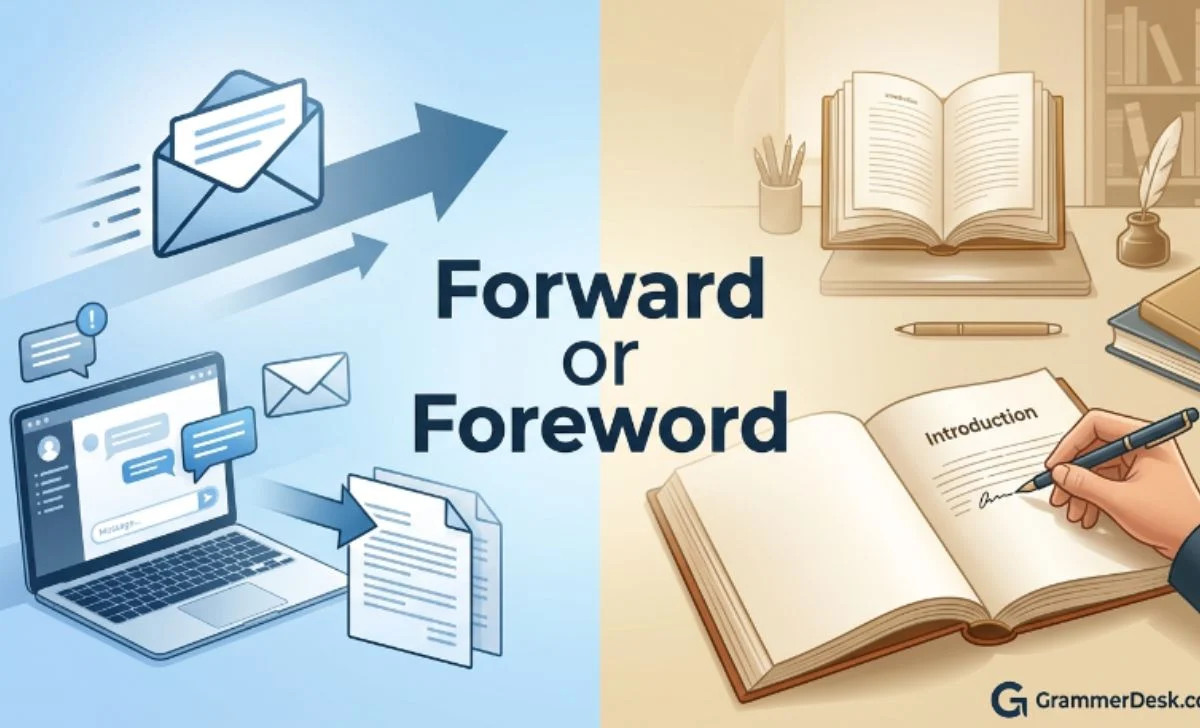
Many English learners get confused when they see the words forward and foreword because they look almost identical but belong to completely different contexts.
One is used in daily communication like emails and messages, while the other appears only in books and publishing. This small spelling difference often leads to major writing mistakes in school, business communication, and even professional publishing.
The confusion exists because both words sound similar and share the same beginning letters. However, their meanings are not interchangeable at all.
forward or foreword helps improve grammar accuracy, writing clarity, and vocabulary confidence.
In this guide, you will learn meanings, pronunciation, usage rules, examples, and simple memory tricks to avoid mistakes.
Quick Answer
Forward means to move ahead or send something onward.
Foreword is an introductory note written in a book.
Simple Comparison
| Word | Meaning | Usage |
|---|---|---|
| Forward | Send ahead / move forward | Emails, communication |
| Foreword | Book introduction | Publishing |
Examples
- Please forward this email to the manager.
- The foreword of the book was written by a famous author.
The key idea: one is action, the other is a book section.
Pronunciation of Forward or Foreword
Even though spelling differs, pronunciation is very similar, which causes confusion.
Pronunciation Guide
- Forward → /ˈfɔːrwərd/ → “FOR-ward”
- Foreword → /ˈfɔːrwɜːrd/ → “FOR-word”
Spoken Meaning
- Forward → action (send, move, progress)
- Foreword → introduction in a book
Example
- I will forward the report.
- I read the foreword of the novel.
Context matters more than sound.
Why People Confuse Forward or Foreword
1. Similar Spelling Pattern
Both words start with “for-”, making them visually confusing.
2. Almost Same Sound
In spoken English, both sound nearly identical.
3. Different Contexts
One belongs to communication, the other to publishing, so learners mix them.
4. Lack of Publishing Knowledge
Many people are unfamiliar with book structure terms like:
- foreword
- preface
- introduction
Easy Trick to Remember Forward or Foreword
A simple memory trick helps avoid mistakes.
Trick 1: Meaning Breakdown
- Forward = move forward (action)
- Foreword = before the word (book section)
Trick 2: Visual Memory
- Forward → arrow ➡️ (movement)
- Foreword → book 📘 (introduction)
Trick 3: Easy Rule
- Emails, messages → forward
- Books, publishing → foreword
The Origin of Forward or Foreword
Forward
The word forward comes from Old English meaning:
- “fore” = ahead
- “weard” = direction
It evolved into a word meaning movement, progress, and sending something ahead.
Foreword
The word foreword is a publishing term meaning:
- “fore” = before
- “word” = written text
It literally means words written before the main content of a book.
British English vs American English Spelling
There is no difference between British and American English in spelling or usage.
| Meaning | British English | American English |
|---|---|---|
| Send ahead | forward | forward |
| Book introduction | foreword | foreword |
Both follow the same global standard.
Which Spelling Should You Use?
Use Forward When:
- Sending emails
- Business communication
- Messaging apps
- Logistics or transport
- General movement or direction
Example:
- Please forward the document.
Use Foreword When:
- Reading or writing books
- Academic publishing
- Literary works
- Editorial content
Example:
- The foreword explains the author’s inspiration.
Simple Advice
If it is not a book → use forward
Common Mistakes with Forward or Foreword
Mistake 1
❌ I read the forward of the book.
✔ I read the foreword of the book.
Mistake 2
❌ Please foreword this message.
✔ Please forward this message.
Mistake 3
❌ The forward was interesting (book context).
✔ The foreword was interesting.
Mistake 4
❌ I will foreword the email.
✔ I will forward the email.
Forward or Foreword in Everyday Examples
Emails
- Please forward this email to the team.
Business Communication
- Forward the report to management.
Books
- The foreword was written by a professor.
Social Media
- I will forward this article to you.
Academic Writing
- The foreword provides background to the research.
Forward or Foreword – Usage Trends
Forward
- Extremely common in daily communication
- Used in emails, business, messaging
Foreword
- Used mainly in publishing and literature
- Less frequent but important in academic writing
Search Behavior
People often search:
- forward or foreword meaning
- difference between forward and foreword
- foreword meaning in book
Forward vs Foreword Comparison Table
| Feature | Forward | Foreword |
|---|---|---|
| Type | Verb / action word | Noun |
| Meaning | Send or move ahead | Book introduction |
| Context | Communication | Publishing |
| Frequency | Very high | Low |
| Usage | Emails, messages | Books |
FAQs
Is forward or foreword correct?
Both are correct but used in different contexts.
What is foreword in a book?
It is an introductory section written before the main content.
What does forward mean?
It means to send or move something ahead.
Can forward be used in books?
No. Books use foreword instead.
Who writes a foreword?
Usually a guest expert or someone other than the author.
Why do people confuse them?
Because they look and sound very similar.
Conclusion
The difference between forward or foreword is simple once you understand context. Forward is used in communication, emails, and movement, while foreword belongs to books and publishing.
The confusion happens because both words look and sound alike, but their meanings are completely different. A simple trick is to remember: forward means moving ahead, while foreword means words placed before a book.
Once you understand this rule, you can avoid one of the most common English mistakes and improve your writing accuracy in both professional and academic contexts.

Hi, I’m Mary Norris, a writer at GrammerDesk.com. I write clear, easy-to-follow articles on English grammar, confusing words, punctuation, spelling, and common writing mistakes to help readers improve their English with confidence.