Have you ever read someone saying “I stayed completely unphased” and wondered if it is correct, or should it actually be unfazed? This small spelling difference confuses many English learners, writers, and even native speakers.
The problem happens because both words sound similar and seem logically connected, especially when describing emotions like calmness or confidence.
However, only one of these words is correct in standard English. Understanding unphased or unfazed helps you avoid common spelling mistakes in academic writing, professional communication, social media posts, and exams.
In this guide, you will learn the correct spelling, meaning, pronunciation, origin, usage rules, and memory tricks. You will also see examples, comparisons, and grammar explanations to clear all confusion permanently.
Unphased or Unfazed – Quick Answer
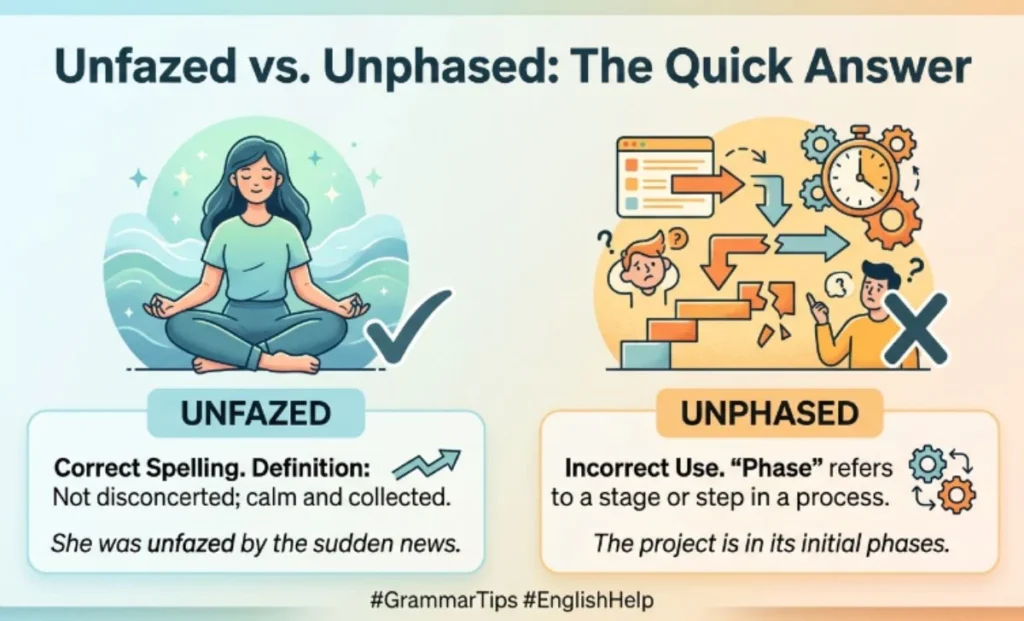
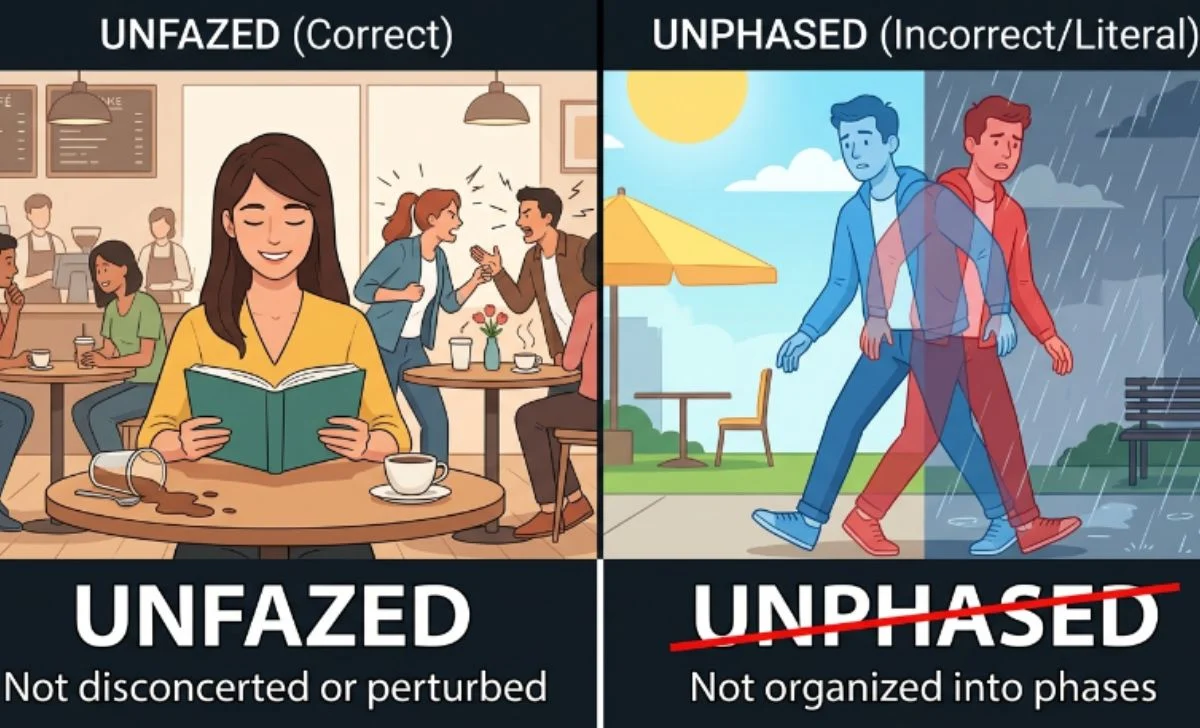
The correct word is unfazed.
Unphased is a common misspelling and is not standard in English dictionaries.
| Word | Correct? | Meaning |
|---|---|---|
| Unfazed | Yes | Calm, not disturbed, not affected |
| Unphased | No | Incorrect spelling |
Examples
- She remained unfazed by the criticism.
- He looked unfazed during the exam pressure.
- ❌ He stayed unphased after the news.
The correct adjective is always unfazed when describing emotional calmness.
Pronunciation of Unphased or Unfazed

The word unfazed is pronounced:
uhn-FAYZD
Phonetic form:
/ʌnˈfeɪzd/
Sound Explanation
- “Un” = weak sound (uhn)
- “Fazed” = rhymes with “amazed”
Spoken Confusion
Because “unphased” and “unfazed” sound identical, people often assume both spellings are correct. However, pronunciation does not reflect spelling rules.
Example in Speech
- She remained unfazed by the noise.
- He was completely unfazed during the interview.
Why People Confuse Unphased or Unfazed
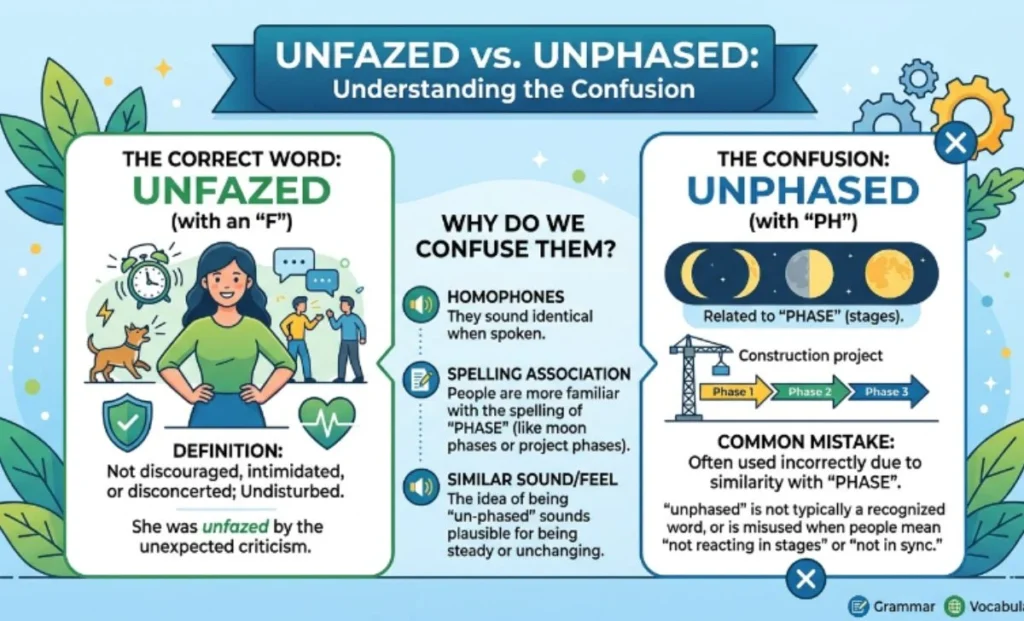
This confusion happens due to several linguistic reasons.
Similar Sounding Words
Both versions are pronounced the same way, leading to spelling confusion.
Influence of the Word “Phase”
People mistakenly connect it with:
- phase → phased → unphased
But this is incorrect in meaning.
Correct Root Word
The correct root is:
- faze (verb) = to disturb or upset
So:
- unfazed = not disturbed
Common Misunderstanding
People assume:
- phase = emotional state
But in grammar:
- faze = correct root word
Easy Trick to Remember Unphased or Unfazed
Use this simple memory trick:
The “Amazed” Trick
Think:
If you are not amazed or disturbed → you are unfazed
Because:
- fazed rhymes with amazed
Quick Formula
- Faze = disturb
- Unfazed = not disturbed
Memory Sentence
“Nothing fazes me, so I stay unfazed.”
This helps lock the correct spelling in memory.
The Origin of Unphased or Unfazed

Origin of “Faze”
The word faze appeared in American English in the 19th century. It means:
- to disturb
- to confuse
- to shake confidence
Formation of “Unfazed”
The prefix un- means:
- not
So:
- unfazed = not disturbed or shaken
Why “Unphased” Exists
The incorrect spelling comes from confusion with the word:
- phase (stage or period)
But phase has nothing to do with emotions.
This misunderstanding created the misspelling unphased.
British English vs American English Spelling
Unlike many words, unfazed is standard in both British and American English.
Comparison Table
| Meaning | British English | American English |
|---|---|---|
| Not disturbed | unfazed | unfazed |
| Incorrect form | unphased | unphased |
Examples
UK:
- She remained unfazed by the situation.
US:
- She remained unfazed by the situation.
No spelling variation exists in standard usage.
Which Spelling Should You Use?
Always Use “Unfazed”
Use it in:
- Academic writing
- Professional emails
- News articles
- Social media captions
- Formal essays
- Exams and tests
Avoid “Unphased”
It is:
- Incorrect in standard English
- Not accepted in dictionaries
- Considered a spelling error
Professional Advice
If you use grammar tools like Grammarly or Microsoft Word, “unphased” will always be flagged as incorrect.
Common Mistakes with Unphased or Unfazed
Mistake #1
Incorrect:
- He remained unphased by the criticism.
Correct:
- He remained unfazed by the criticism.
Mistake #2
Incorrect:
- She looked unphased during the meeting.
Correct:
- She looked unfazed during the meeting.
Mistake #3
Incorrect:
- Nothing can unphase me.
Correct:
- Nothing can faze me.
Mistake #4
Incorrect:
- The news left him unphased.
Correct:
- The news left him unfazed.
Mistake #5
Confusing root words:
Incorrect assumption:
- phase → emotional reaction
Correct understanding:
- faze → emotional disturbance
Unfazed in Everyday Examples
Emails
- I remained unfazed during the client discussion.
News Writing
- The athlete stayed unfazed despite heavy pressure.
Social Media
- Unfazed by Monday chaos 😎
Academic Writing
- Participants remained unfazed under experimental stress conditions.
Professional Communication
- The manager appeared unfazed during the crisis meeting.
Journalism
- The leader was unfazed by public criticism.
Casual Usage
- I was totally unfazed by the noise outside.
Unphased or Unfazed – Google Trends & Usage Data
Search Patterns
Most searches appear as:
- unphased or unfazed
- is unphased correct
- unfazed meaning
- unfazed definition
Global Usage
The correct term unfazed is widely used in:
- United States
- United Kingdom
- Canada
- Australia
- New Zealand
Popular Contexts
- Psychology and behavior descriptions
- Sports commentary
- News reporting
- Social media expressions
- Motivational writing
Why “Unphased” Appears Online
- Typing errors
- Misunderstanding of “phase”
- Auto-correct mistakes
But search data shows unfazed dominates correct usage.
Unphased vs Unfazed Comparison Table
| Feature | Unphased | Unfazed |
|---|---|---|
| Correct spelling | No | Yes |
| Dictionary accepted | No | Yes |
| Meaning | None (incorrect form) | Not disturbed |
| Based on root word | Phase (wrong context) | Faze (correct root) |
| Usage in writing | Error | Standard |
| Academic acceptance | No | Yes |
Related Confusing Word Pairs
- affect or effect
- discreet or discrete
- accept or except
- lose or loose
- principal or principle
- advice or advise
- practice or practise
- stationary or stationary confusion
- then or than
- compliment or complement
FAQs
Is unphased a real word?
No. “Unphased” is not a standard English word.
What does unfazed mean?
It means calm, unaffected, or not disturbed by something.
Why do people write unphased?
Because they confuse “faze” with “phase.”
Is unfazed formal or informal?
It is neutral and can be used in both formal and informal writing.
How do you use unfazed in a sentence?
- She remained unfazed during the emergency.
What is the opposite of unfazed?
Opposites include:
- disturbed
- shocked
- affected
- rattled
Can I use unphased in writing?
No. It is considered incorrect in standard English.
Conclusion
The correct spelling is unfazed, not unphased. This confusion happens because people mistakenly link the word to “phase,” but the correct root is “faze,” which means to disturb or upset.
Understanding this difference helps you avoid one of the most common English spelling mistakes. Whether you are writing emails, academic papers, social media posts, or professional documents, always use unfazed to express calmness and emotional control.
Remember the simple rule: if something does not disturb you, you are unfazed. Mastering this small distinction improves your writing accuracy, grammar confidence, and overall English communication skills.
Related Posts:

Hi, I am Constance Hale, an author featured on Grammerdesk.com. I focus on language, writing style, and grammar, helping readers improve clarity, expression, and effective communication in English.