Have you ever written judgement and wondered if it should be judgment instead? You’re not alone.
This is one of the most common spelling questions in English because both versions appear in books, websites, legal documents, and dictionaries.
The confusion mainly comes from differences between British and American English. While both spellings are accepted in certain situations, one is more widely preferred depending on the region and style guide you follow.
In this guide, you’ll learn the meaning of the word, the difference between judgement and judgment, how major dictionaries treat them, and which spelling to use in academic, professional, and everyday writing.
Quick Answer
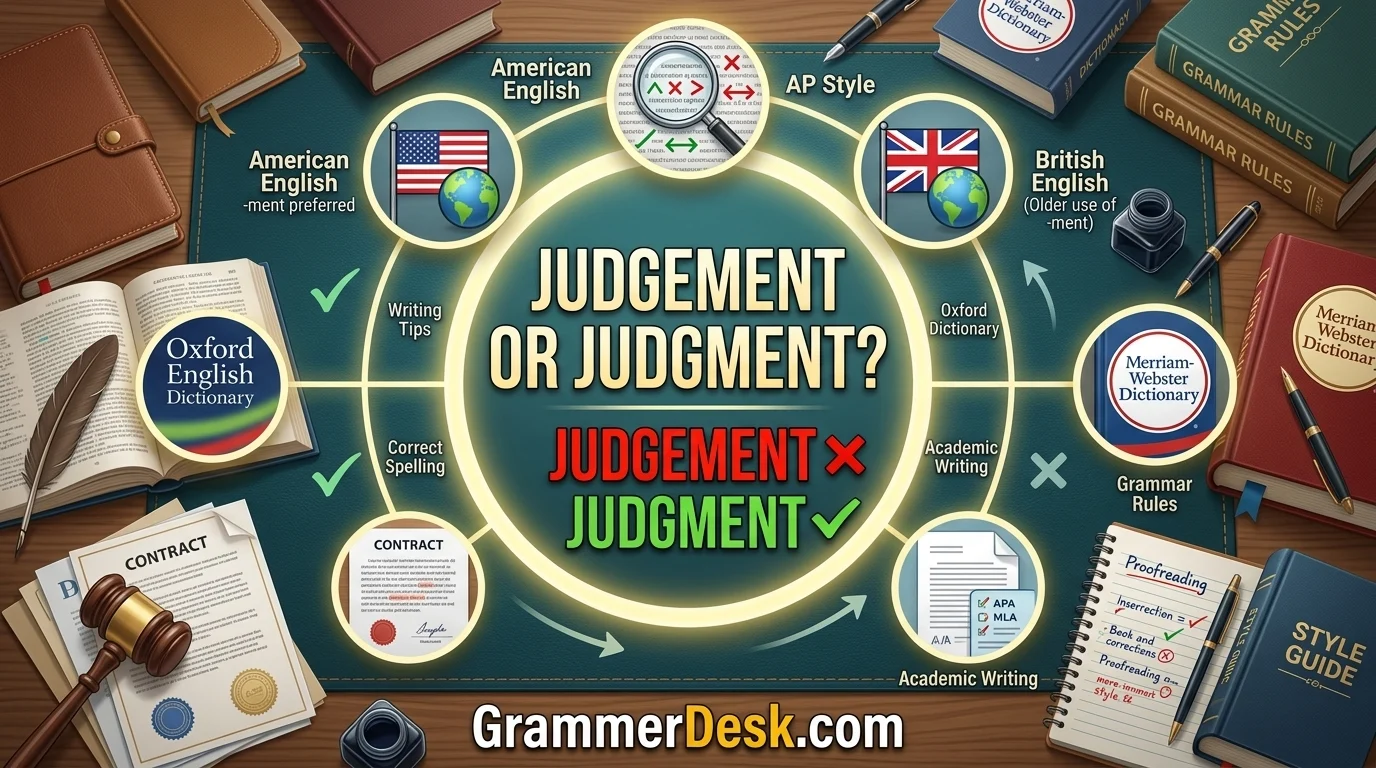
Judgment is the preferred spelling in American English and is also the standard form used by many major style guides and dictionaries.
Judgement is an accepted variant spelling that appears mainly in British English, although many British publishers and organizations also use judgment.
Correct Example
- The court delivered its judgment yesterday.
- She showed good judgment in a difficult situation.
Also Accepted in British English
- His judgement was respected by the entire team.
- The committee trusted her judgement.
Quick Summary Table
| Region | Preferred Spelling |
|---|---|
| United States | Judgment |
| United Kingdom | Judgment or Judgement |
| Canada | Usually Judgment |
| Australia | Judgment or Judgement |
| Academic Writing | Usually Judgment |
| AP Style | Judgment |
What Does Judgment Mean?
The word judgment is a noun that refers to an opinion, decision, conclusion, or evaluation made after careful thought.
Depending on the context, it can describe a personal opinion, a legal ruling, or the ability to make sensible decisions.
Common Meanings
- A decision reached after consideration
- An opinion about someone or something
- An assessment or evaluation
- A court ruling or legal decision
- The ability to make wise choices
Simple Usage Examples
- Good judgment comes from experience.
- The judge announced the final judgment.
- In my judgment, the plan will succeed.
- She demonstrated excellent judgment during the crisis.
The Origin of Judgment and Judgement
Understanding the history of the word helps explain why both spellings exist today.
Word History
The word comes from the Old French jugement and ultimately traces back to the Latin word judicare, meaning “to judge.”
Over time, English spelling evolved differently across regions. Some writers retained the extra e in judgement, while others dropped it and adopted judgment.
Why the Confusion Happens
Many English words ending in -ment keep the silent e before the suffix. Because of this pattern, some writers naturally assume that judgement should be the standard spelling.
However, historical usage and modern style guides increasingly favor judgment, especially in formal writing.
Judgment vs Judgement in English
One reason people search for “judgement or judgment in English” is that both spellings appear in English-language publications.
The Main Difference
There is no difference in meaning between the two spellings.
The distinction is primarily based on regional preference and editorial style.
Comparison Table
| Feature | Judgment | Judgement |
|---|---|---|
| Meaning | Same | Same |
| American English | Preferred | Rare |
| British English | Common | Common |
| Academic Writing | Preferred | Less Common |
| AP Style | Preferred | Not Preferred |
| Legal Writing | Preferred | Less Common |
British English vs American English
Regional spelling differences are common in English.
Examples include:
| American English | British English |
|---|---|
| Color | Colour |
| Favor | Favour |
| Organize | Organise |
| Judgment | Judgement or Judgment |
United States Usage
In the United States, judgment is overwhelmingly preferred.
American dictionaries, universities, publishers, and style guides generally recommend this spelling.
United Kingdom Usage
In the United Kingdom, both forms are accepted. However, many modern British publications increasingly use judgment, particularly in legal and academic contexts.
What Does the Oxford Dictionary Say?
Many writers search for “judgement or judgment Oxford dictionary” because they want a trusted authority.
The Oxford dictionaries recognize both spellings. However, judgment is often presented as the preferred spelling, while judgement is listed as a variant form. This reflects modern usage trends in English.
Writers following Oxford style recommendations can confidently use judgment, especially in formal writing.
Judgement or Judgment in Grammar
From a grammar perspective, there is no difference between the two spellings.
Grammar Rule
Both words function as nouns.
Examples:
- Her judgment was accurate.
- His judgement impressed the committee.
The grammatical role remains identical regardless of spelling.
Why Grammar Experts Prefer Judgment
Many grammar experts recommend judgment because it is more widely accepted internationally and aligns with major style guides.
As a result, it often creates less confusion for readers.
Judgement or Judgment in Academic Writing
Academic writing values consistency, clarity, and adherence to style guidelines.
Which Spelling Should Students Use?
For most academic papers, dissertations, journal articles, and research projects, judgment is the safer choice.
Many universities, academic publishers, and citation styles favor this spelling.
Best Practice
If you’re writing for a British institution that specifically prefers British spelling conventions, follow the style guide provided by your school or publisher.
Otherwise, judgment is usually the recommended option.
Judgement or Judgment in AP Style
The Associated Press Stylebook is one of the most influential style guides in journalism.
AP Style Recommendation
AP Style recommends judgment.
This spelling is used in:
- News articles
- Press releases
- Professional journalism
- Media publications
Writers following AP Style should avoid judgement unless quoting a source directly.
Judgment in Legal Writing
Legal writing follows its own conventions.
Why Legal Documents Use Judgment
In courts and legal systems, judgment is the standard spelling.
The term commonly refers to:
- Court judgments
- Judicial opinions
- Legal rulings
- Case decisions
Examples:
- The court issued its final judgment.
- The appeal challenged the original judgment.
Because legal writing strongly favors this spelling, many style guides consider it the default form.
Judgement or Judgment Examples
Seeing the word in context makes the distinction easier to understand.
Everyday Examples
- Good judgment helps people make better decisions.
- She trusted her own judgment.
- His judgement was respected by colleagues.
- The manager praised her judgment.
Professional Examples
- The board exercised sound judgment.
- Strong judgment is an important leadership skill.
- The committee relied on expert judgement.
Legal Examples
- The judge announced the judgment.
- The lawyer appealed the court’s judgment.
Which Spelling Should You Use?
The best spelling depends on your audience.
For American Readers
Use judgment.
For Academic Writing
Use judgment unless instructed otherwise.
For Business Writing
Use judgment because it is more widely recognized internationally.
For Journalism
Use judgment to comply with AP Style.
For British Audiences
Both forms may be accepted, but judgment is increasingly common.
Common Mistakes to Avoid
Writers often make a few common mistakes when using this word.
Frequent Errors
- Assuming one spelling has a different meaning
- Mixing both spellings in the same document
- Ignoring style guide requirements
- Using regional spelling inconsistently
Corrected Examples
| Incorrect | Correct |
|---|---|
| The judgement was fair. (US document) | The judgment was fair. |
| Judgment and judgement used together | Choose one style and remain consistent. |
| Ignoring style rules | Follow the required style guide. |
Related Grammar Rules
This spelling question belongs to a larger group of commonly confused English words.
Similar Spelling Differences
- Color vs Colour
- Honor vs Honour
- Organize vs Organise
- Traveler vs Traveller
- Center vs Centre
Helpful Writing Tips
- Follow one spelling system consistently.
- Check your style guide before publishing.
- Use trusted dictionaries when uncertain.
- Prioritize clarity over personal preference.
FAQs
Is judgment or judgement correct?
Both spellings are correct, but judgment is generally preferred in American English and formal writing.
Which spelling does Oxford Dictionary prefer?
Oxford recognizes both forms, though judgment is commonly treated as the preferred spelling.
Is judgement wrong?
No. It is an accepted variant spelling, especially in British English.
Which spelling is used in AP Style?
AP Style recommends judgment.
Which spelling should I use in academic writing?
Most academic institutions and publishers prefer judgment.
Is there a difference in meaning between judgment and judgement?
No. Both words have the same meaning.
Why do people spell it judgement?
The spelling follows traditional British conventions and historical English usage.
Which spelling is more common today?
Overall, judgment is more common across modern English publications, style guides, and professional writing.
Conclusion
The debate over judgement or judgment comes down to spelling preference rather than meaning.
Both forms are recognized in English, but judgment is the dominant choice in American English, legal writing, journalism, business communication, and most academic settings.
While judgement remains acceptable in some British contexts, using judgment will generally align with major dictionaries, style guides, and modern publishing standards.
If you’re unsure which version to choose, follow your audience’s regional preference and remain consistent throughout your writing.
Doing so will make your work look polished, professional, and easy to understand.

Hi, I’m Gerald Graff, a writer at GrammerDesk.com. I create simple, practical guides on English grammar, confusing words, homophones, spelling, and common language mistakes to help readers write and communicate with confidence.