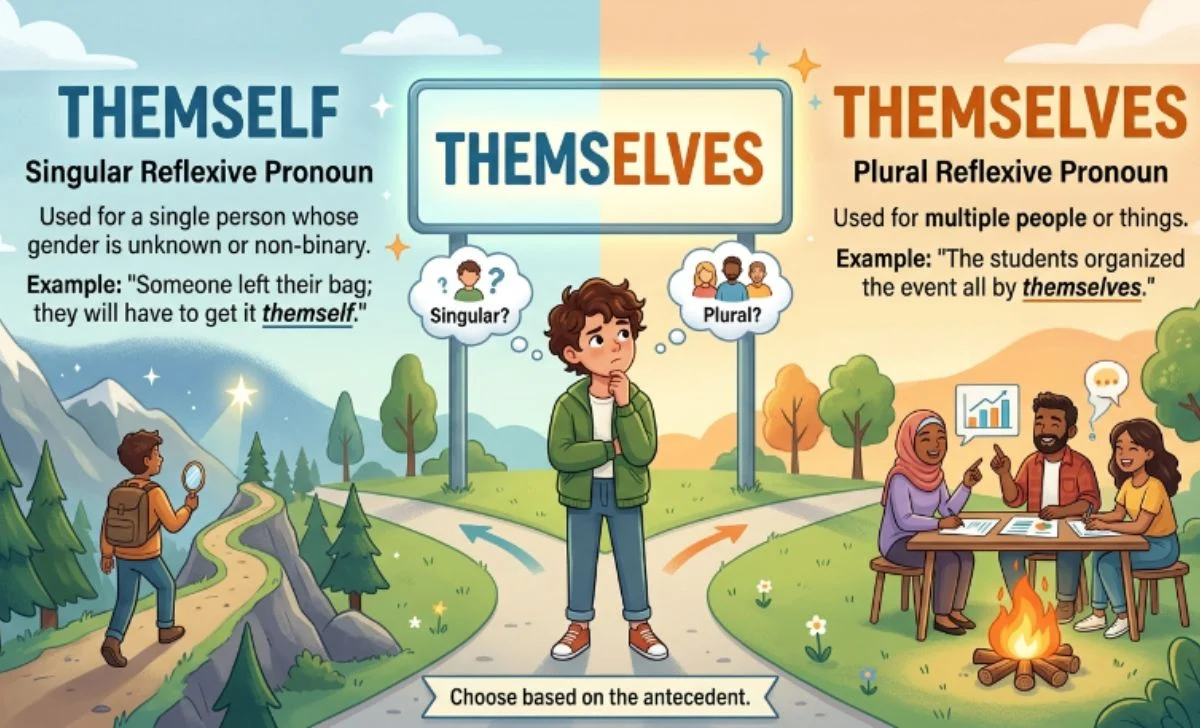
Have you ever seen someone write “themself” and wondered if it is correct, or if it should always be “themselves”? This is a common confusion in modern English grammar, especially because language is changing and pronouns are becoming more flexible.
Many learners, writers, and even native speakers struggle with this because both forms appear in informal writing, social media, and sometimes even published content.
The confusion mainly comes from the rise of singular they, gender-neutral language, and evolving grammar rules in English. Understanding the difference between themself or themselves helps you write correctly in academic, professional, and everyday contexts.
In this guide, you will learn meanings, pronunciation, grammar rules, usage examples, common mistakes, and when each form is appropriate.
Quick Answer
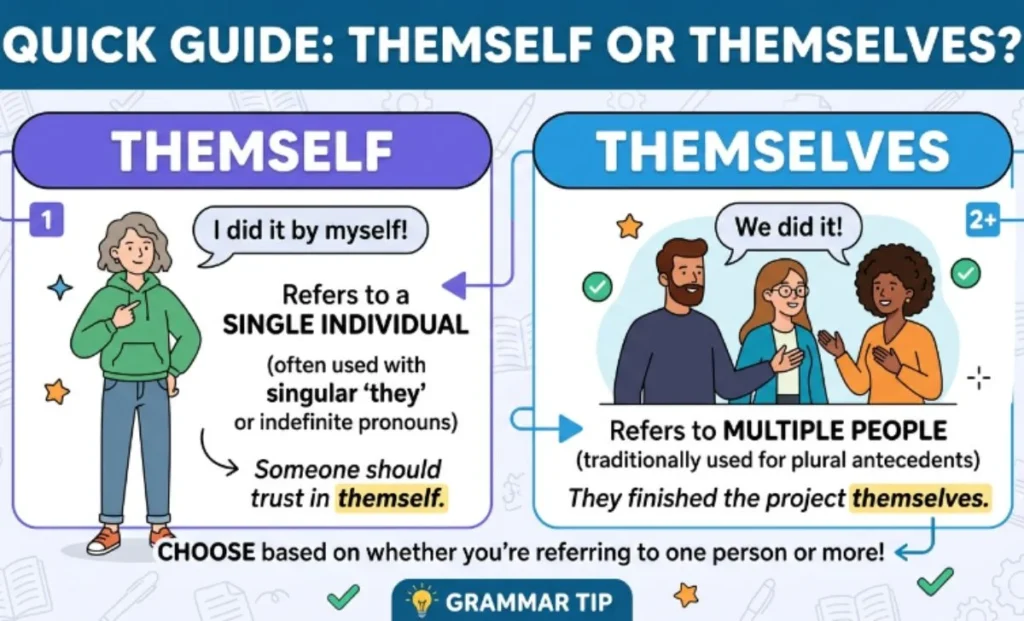
Themselves is the standard plural reflexive pronoun in English.
Themself is increasingly used in modern English, especially for singular “they”, but it is still considered informal or nonstandard in many grammar systems.
| Word | Correctness | Usage |
|---|---|---|
| Themselves | Standard | Plural reflexive pronoun |
| Themself | Informal / emerging | Singular “they” reflexive form |
Examples
- They washed themselves after the game.
- Each student should bring themself to class prepared. (informal/modern usage)
In formal writing, themselves is preferred.
Pronunciation of Themself or Themselves
Both words are easy to pronounce but slightly different in rhythm.
Pronunciation
- Themselves → /ðəmˈselvz/ → “thuhm-SELVZ”
- Themself → /ðəmˈself/ → “thuhm-SELF”
Spoken Explanation
- Themselves sounds plural and ends with “-selvz”
- Themself sounds singular and ends with “-self”
Spoken Examples
- They should take care of themselves.
- Each person should take care of themself.
Even though pronunciation is similar in fast speech, the grammar meaning is different.
Why People Confuse Themself or Themselves
There are several reasons this confusion happens in English grammar.
Singular They Usage
Modern English increasingly uses singular they:
- Someone left their bag behind.
- Each student should bring their book.
So logically:
- Each student should help themselves → becomes confusing
- Some writers prefer → themself
Similar Grammar Structure
Both words come from reflexive pronoun patterns:
- himself
- herself
- themselves
- itself
So users try to create a matching singular form: themself
Informal Internet Usage
Social media and online writing often use:
- themself instead of themselves
This increases confusion in formal writing.
Grammar Variation
Some dictionaries now accept themself in specific contexts, but not all style guides agree.
Easy Trick to Remember Themself or Themselves
A simple rule can help you avoid mistakes.
The Plural Rule
- More than one person → themselves
- One person (singular they) → themself (informal)
Memory Trick
“They = plural feeling → themselves
They (singular) = modern use → themself”
Simple Formula
- Formal writing → always use themselves
- Casual modern writing → themself may appear
Example Trick
- Group of students → themselves
- Each student → themselves (formal still preferred)
The Origin of Themself or Themselves
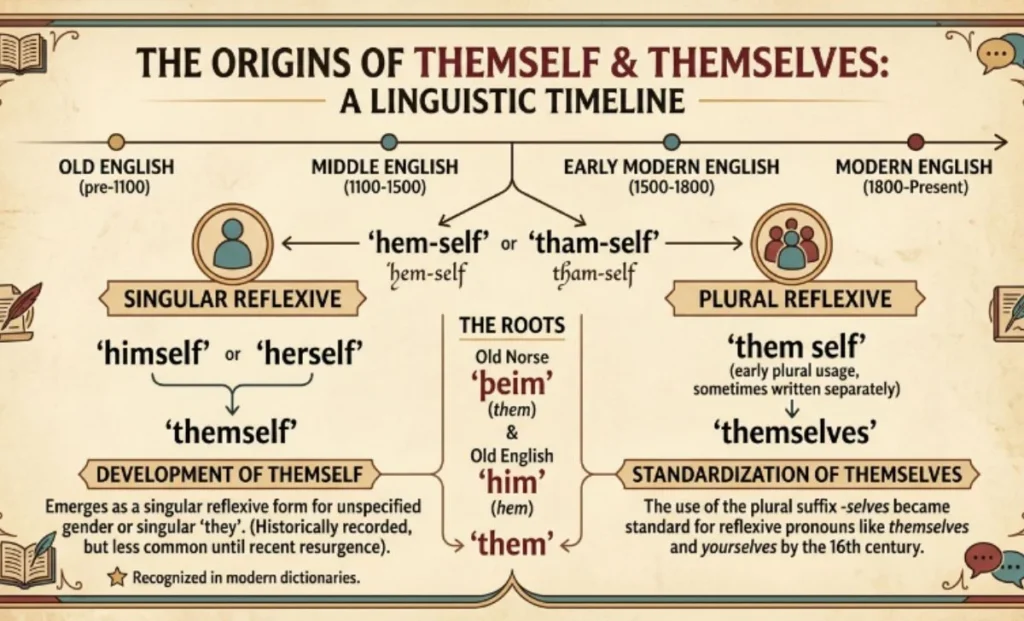
Themselves Origin
The word themselves comes from Old English reflexive forms combining:
- “them” (object form of they)
- “selves” (plural of self)
It has been standard in English for centuries.
Themself Origin
Themself is a newer development that emerged with:
- Modern gender-neutral language
- Singular they usage
- Inclusive writing trends
Historically, English did not require a singular reflexive form for “they,” but language evolution created space for it.
British English vs American English Spelling
Unlike spelling differences like “color/colour,” this case is about usage preference, not spelling variation.
Comparison Table
| Feature | British English | American English |
|---|---|---|
| Standard reflexive form | Themselves | Themselves |
| Themself usage | Rare | Rare |
| Singular they acceptance | Increasing | Increasing |
Both varieties still prefer themselves in formal writing.
Which Spelling Should You Use?
The choice depends on context and audience.
Use Themselves When:
- Writing academic papers
- Writing exams
- Professional emails
- News articles
- Formal documents
- Business communication
Example:
- Each employee should submit their report themselves.
Use Themself When:
- Informal writing
- Creative writing
- Social media posts
- Gender-neutral personal style guides (rare cases)
Example:
- Everyone should feel free to be themself.
Professional Advice
If you are unsure, always choose:
✔ Themselves
It is universally accepted.
Common Mistakes with Themself or Themselves
Mistake #1
❌ Each student should help themself in exams.
✔ Each student should help themselves in exams.
Mistake #2
❌ They completed the task by themself (formal writing).
✔ They completed the task themselves.
Mistake #3
❌ Themselves person is responsible.
✔ The person themselves is responsible.
Mistake #4
❌ Each worker should bring themselves equipment.
✔ Each worker should bring their own equipment.
Mistake #5
❌ Using themself in formal academic writing
✔ Avoid it unless style guide allows it
Themself or Themselves in Everyday Examples
Emails
- Please ensure all team members submit their documents themselves.
News Writing
- Each witness described what they saw themselves.
Social Media
- People should express themself freely. (informal usage)
Academic Writing
- Participants were asked to evaluate themselves after the test.
Business Communication
- Employees are responsible for managing themselves during training.
Themself or Themselves – Usage Trends
Themselves Dominates Usage
Across dictionaries, books, and academic writing:
- Themselves is the standard form
- Used in over 95% of formal writing
Rise of Themself
Themself appears more in:
- Social media
- Gender-neutral writing
- Online communities
- Creative content
Regional Usage
- US English: prefers themselves
- UK English: prefers themselves
- Global English: mostly themselves
Linguistic Trend
The rise of singular they is pushing gradual acceptance of “themself,” but it is still not fully standardized.
Themself vs Themselves Comparison Table
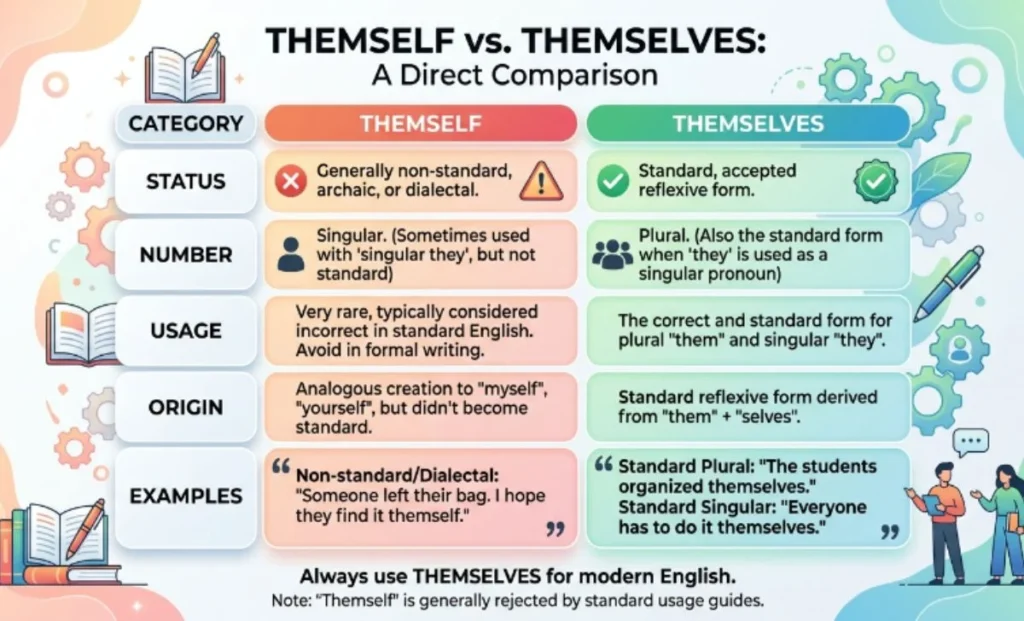
| Feature | Themself | Themselves |
|---|---|---|
| Grammar status | Informal / emerging | Standard |
| Formal usage | Not recommended | Recommended |
| Plural use | No | Yes |
| Singular they use | Yes | Sometimes |
| Academic writing | Avoid | Required |
| Social media usage | Common | Common |
| Dictionary acceptance | Limited | Universal |
Related Grammar Concepts
Understanding these helps clarity.
Reflexive Pronouns
- myself
- yourself
- himself
- herself
- itself
- ourselves
- yourselves
- themselves
Singular They
Used when gender is unknown:
- Someone left their bag.
- Each student brought their book.
Inclusive Language
Modern English increasingly supports:
- gender-neutral pronouns
- inclusive grammar structures
FAQs
Is themself a real word?
Yes, but it is informal and not widely accepted in formal grammar.
Is themselves correct?
Yes, it is the standard reflexive pronoun for plural and formal writing.
When should I use themself?
Only in informal or gender-neutral modern contexts.
Why do people use themself?
Because of singular “they” and inclusive language trends.
Can I use themself in essays?
No, unless your style guide specifically allows it.
What is singular they?
It is the use of “they” to refer to one person without gender.
What is the safest choice?
Always use themselves in formal writing.
Conclusion
The difference between themself or themselves is simple but important in English grammar. Themselves is the correct and standard reflexive pronoun used in formal, academic, and professional writing.
Themself is a modern, informal form that appears mainly in gender-neutral or casual contexts but is not widely accepted in formal grammar rules. The confusion comes from the rise of singular “they” and the natural evolution of English pronouns.
If you are unsure, always choose themselves to stay correct and professional. Understanding this distinction helps improve clarity, accuracy, and confidence in your writing across all contexts.
Related Posts:
- Unphased or Unfazed? Which Spelling is Correct in Modern English
- Whisky or Whiskey – What Is the Real Difference in Spelling

Hi, I’m Gerald Graff, a writer at GrammerDesk.com. I create simple, practical guides on English grammar, confusing words, homophones, spelling, and common language mistakes to help readers write and communicate with confidence.